 Rhodophyta- Florideophycidae
Sexual Reproduction-2
Rhodophyta- Florideophycidae 
Carpogonia are produced on short branches of Female thalli.
Each Carpogonium is a single Cell that produces an extension called the Trichogyne.
The Carpogonium is surrounded by sterile tissue called Pericarp.
The cells of the Pericarp fuse but leave an apical opening called the Ostiole.
The tip of the Trichogyne protrudes through the Ostiole.
Polysiphonia Gametophyte |
Polysiphonia - Vegetative Branch Tips |
|
|
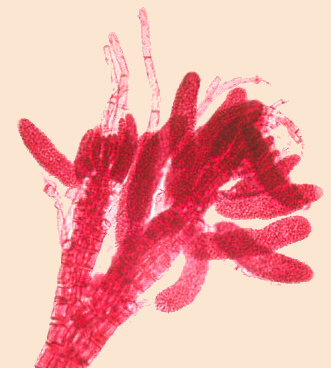 Polysiphonia Male Branch Tips bearing Spermatangia |
 Thallus of a Rhodophyta with Carpogonium that shows the Trichogyne |
Spermatangia occur in cone-like clusters at the tips of fertile branches.
Each Spermatangium produces one Spermatium.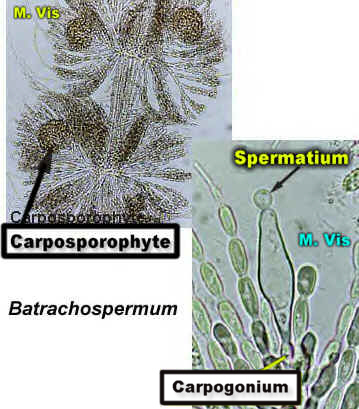
The Sperm are naked, nonmotile cells.
They float freely in the water.
If they encounter a compatible Trichogyne, they fuse with it.
The Male Nucleus achieves Fertilization and produces a Diploid Zygote.
The Trichogyne Degenerates.
The Zygote Nucleus migrates into one of the adjoining sterile cells.
 Section through a female Conceptacle showing Carposporophyte with its Caropsporangia (C). Each Carposporangium produces one Carpospore. |
 |
Mitotic
Divisions produce a Diploid Thallus that is called the
Carposporophyte. It is a Sporophyte (2N) that develops in a
Carpogonium. Hence its name!
Terminal Cells of the Carposporophyte become Sporangia.
They produce DIPLOID Carpospores.
Each Sporangium produces a naked Carpospore which escapes through the Ostiole.
The Perianth may degenerate and facilitate the release of the Carpospores.
The Carpospores Germinate and produce the Tetrasporophyte.
The Tetrasporophyte has a morphology that is Identical to the Haploid Gametophytes (Isomorphic)
Tetrasporangia (Meiosporangia) are not produced is special structures.
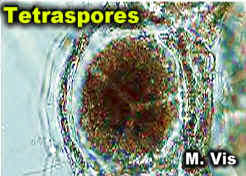
Solitary Vegetative cells enter Meiosis and produce four haploid "Tetraspores".
|
|
| After the Tetraspores
are released, they germinate and develop into Haploid Gametophytes. |
 |
There are many more complex and
cryptic life cycles in the Rhodophyta. However, this is sufficient for this class. Dr.
Celia Smith offers excellent classes that deal with algae and I encourage you to take
classes with her. Link to Life Cycle Diagram 
Link to Derek Keys
Coralline Algae Life Cycle 


