Rhodophyta- Florideophycidae

Sexual Reproduction-1
Rhodophyta- Florideophycidae

|
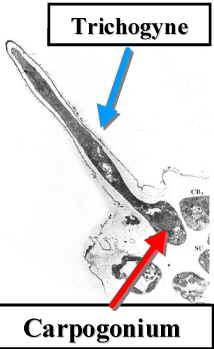
The Carpogonium produces an outgrowth called the Trichogyne (Female Hair). This is a Receptive Hair to which compatible sperm can bind.
 |
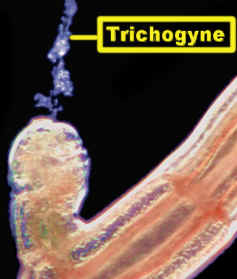 |
 Female Thallus of Bostrychia with Trichogynes (white hairs) |
 Detailed view of the left-hand image showing the Trichogynes and Carpogonia. |
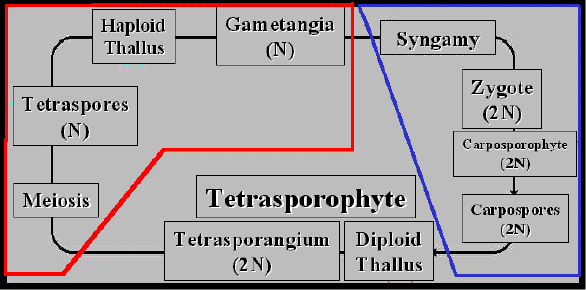 |
| Generalized Sexual Reproductive Cycle for a Red Alga (Florideophyceae) |
These are released and germinate to form another Diploid Organism which is called the Tetrasporophyte. The name means that it is a Sporophyte that will produce Meiospores which form a Tetrad following Meiosis.
Tetraspores are produced in a Tetrasporangium.
The mature Tetraspores (N) are released and germinate to produce Haploid Gametophytes (Male or Female). These will form Gametangia when they are mature and begin the life cycle all over again.
This
may seem complex but it only inserts an
additional Diploid Phase (Carposporophyte) in the Life Cycle.