WB01343_.gif (599 bytes)     Rhodophyta-2     WB01345_.gif (616 bytes)

Organelles

Halydictyon250.jpg (26376 bytes)

Halydictyon sp.- (A Coenocyte) Its Nuclei are Stained with DAPI

Nucleus

Some simple organisms are Uninucleate.

Complex Organisms are Multinucleate (Coenocytic).

There can be  100 to  1000 Nuclei per cell!

They are Eukaryotes and have True Chromosomes. N = 2 - 90

Cell Division & New Wall OrganizationPitPlugLMVisHue.jpg (64369 bytes)

The New Cell Wall exhibits Annular Growth.New Wall formation starts from the Outside and proceeds centripetally (towards the center).This is similar to closing an Iris Diaphragm like the Field Diaphragm of a microscope or the diaphragm in a camera lens or in your eye.PitConnectionLab.jpg (55232 bytes)

A large opening remains between the two cells. A Protein Plug completely blocks cytoplasmic continuity.

This is called the "Primary Pit Connection" and is unique to Rhodophyta.

Chloroplasts

There can be from one to many chloroplasts per cell.

ChlPlastPorph300Lab.jpg (64887 bytes)

Porphyridium Cell Showing the Chloroplast & Nucleus

Simple Forms have 1 to several.

Larger More Complex Forms have many Small chloroplasts.

Ultrastructure

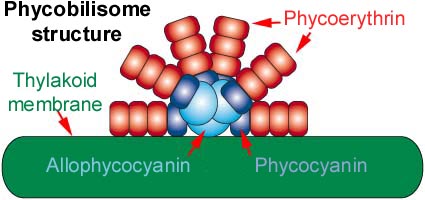
Chloroplasts have a Double Limiting Membrane with Solitary Thylakoids that are Widely Spaced. This is partly due to the presence of Phycobilisomes which protrude above the surface of the Thylakoids.

PhycobilisomeDraw.jpg (28474 bytes)

Pyrenoids may be present. These have high Concentrations of RUBISCO, the enzyme involved in the Fixation of CO2. Pyrenoids may allow carbon fixation at lower CO2 levels.
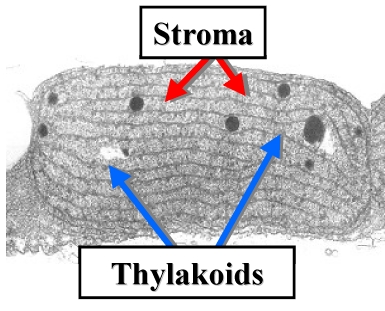
The Stroma (matrix) is Homogenous &

ChlpLaurencia300Lab.jpg (88190 bytes)

Chloroplast of Laurencia

DNA is present.

Starch (Floridean Starch) is stored in the Cytoplasm which also contains, Mitochondria, Dictyosomes, Endoplasmic Reticulum & Ribosomes.


WB01342_.gif (1360 bytes)