WB01343_.gif (599 bytes)     Meristems-7  WB01345_.gif (616 bytes)
311 Syllabus


There are two basic types of Shoot Apical Meristems

VegetativeFloral

We have examined Vegetative Meristems.

These have Indeterminate (unlimited) growth.

They produce Developmental units called Phytomeres

These include Leaves which define Nodes &

Stem segments called Internodes

Axillary (Secondary) Branches develop at the Nodes.


Floral Meristems

When the Primary Shoot Apical Meristem produces a Flower, the vegetative SAM undergoes a series of events which results in the production of  Flower Parts rather than Leaves. The floral organs are highly modified Leaves!

This kind of  Meristem is called FLORAL!

Floral Meristems have Determinate Growth. This means that all of the cells in the Apical Meristem differentiate as part of the Flower and that no additional meristematic activity occurs in that Apical Meristem

The SAM becomes a Floral Apical Meristem DIRECTLY!


Inflorescence Meristems

In some cases, the Primary Shoot Apical Meristem does NOT form a Flower itself.

It produces  modified leaves called Bracts

the Secondary  Meristems which develop in the axil of the Bract become Floral Meristems.

Inflorescence Meristems may be Determinate or Indeterminate.

Pineapple is an example of this.

The Vegetative Meristem produces Leaves

It becomes an Inflorescence Meristem

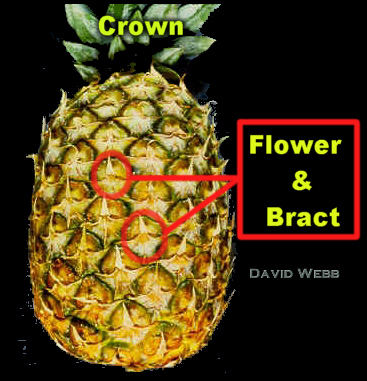
The Pineapple inflorescence contains many small flowers.

Each flower has a prominent Bract.

The Inflorescence Meristem which produced the Secondary Floral Meristems can revert to a  Vegetative Meristem and can produce Leaves instead of Bracts.

This forms the "crown" of the Pineapple and can be used to grow a new plant.

PineapplePlantVegLvsInflorLab300.jpg (93895 bytes)
Side View of a Pineapple Plant that has resumed Vegetative growth following the production of Flowers (Inflorescence).
PineApplePolarFlrLab300.jpg (123552 bytes)
Top View of a Pineapple Inflorescence. Note the purple Flowers which stick out of the axis.
PineAppleFlrsCropLab300.jpg (94477 bytes)
Pineapple Inflorescence: Each Bract marks the location of one Flower.
PineAppleFruLab250.jpg (63854 bytes)
Pineapple labeled to indicate the Flower/Bract units which comprise the Inflorescence and the Crown which produces vegetative leaves
PineAppleLeafprim-3Lab400.jpg (97346 bytes)
Scanning Electron Microscope image of a pineapple Vegetative SAM. Note that it produces a FEW LARGE LEAF PRIMORDIA.
PineAppleSAMDay-12-Crop-HuePartLab300.jpg (75272 bytes)
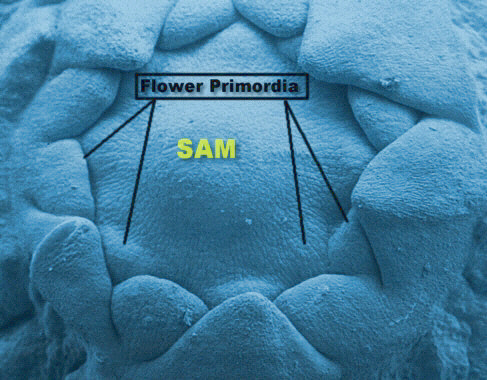
Scanning Electron Microscope image of Pineapple Inflorescence SAM. Note that it has produced Many Smaller Primordia than the Vegetative SAM

Long Section through a mature Pineapple. The areas indicated by F represent the Fruits of the Individual Flowers. Note the location of the Shoot Apical Meristem at the tip of the Crown. It was an inflorescence Meristem when it produced Axillary Flowers. It has reverted to a Vegetative SAM and is producing vegetative Leaves instead of  Floral Bracts.

PineappleFruLSMacroLab250.jpg (70886 bytes)

Banana is another Example!

BananaFlrFruPendant200Lab.jpg (106568 bytes)

BananaSAMLab400.jpg (149137 bytes)
The Banana plant is like a giant Celery. Its Shoot Apical Meristem (SAM)  is located near ground level. There is little Internodal Elongation and the Leaf Primordia (LP) are crowded near the SAM. Rapid, extensive elongation occurs at the onset of flowering. Vegetative Leaves are replaced by Bracts. Flower Buds develop in the Axil of Each Bract.

BananaSAMLabCrop.jpg (129540 bytes)

BananaFkrShooTip300Lab.jpg (135343 bytes)

BananaInflorVertFruitsCCCLab.jpg (68189 bytes)
Banana Inflorescence: Note the Bracts which are modified Leaves and the Flower Primordia which occur in the axil of each Bract. Banana Inflorescence: Note the Bracts and their Axillary Flowers.
BananaInflorBractsExternal240.jpg (70741 bytes) BananaFlrs200.jpg (60875 bytes)

Hanging Banana stem showing the Bracts at the summit of the Inflorescence.

The Flowers are revealed when the Bracts are peeled back.

WB01342_.gif (412 bytes)