|
 Prior Page |
 Next Page |
|
Prior Page |
Next Page |

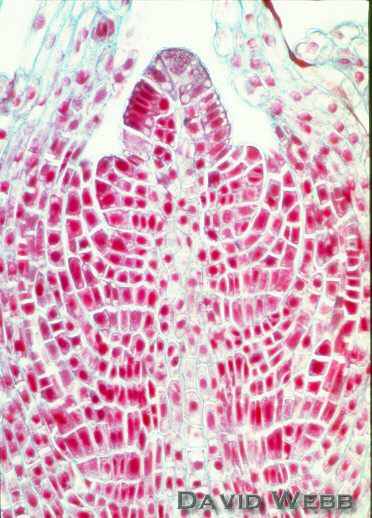
Most Plants exhibit Apical Growth.
This is characterized by the following features.
 |
An Apical
Meristem produces all of the cells which will contribute to the growth of the axis
(stem or root). |
|
Derivatives
of the Apical Meristem divide for a fixed time. |
|
However, as they are displaced by new derivatives, they cease to divide & they
differentiate. |
|
Differentiation
involves progressive cell enlargement in all directions. |
|
This usually results in cells with a rectangular shape. |
|
These are longer and wider than
their progenitors. |
|
Consequently, there is a gradient in cell shape & size, from small & isodiametric to large & elongate. |
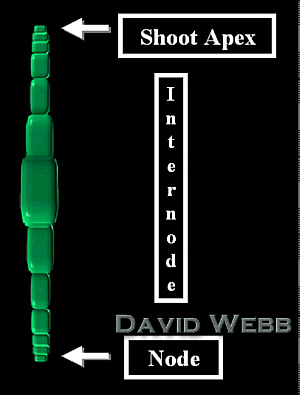
This is illustrated in the following diagram.
This diagram shows the progression of one cell during its course of development. Cells at the Apex are small and isodiametric. As they are displaced by newly produced cells, they enlarge by gaining increased length and depth until they mature and stop growing. This produces a wedge-shaped file of cells which is wide at the Node and pointed at the Apex. |
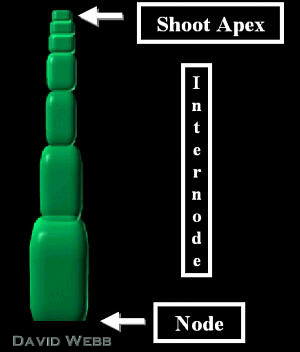 |
When we consider many cell files that develop in the same fashion we get a structure which looks like the one to the right. The segments are intended to show cells at each step along the Internode. However, they could also indicate Nodes along the stem. This type of growth is the most common one found in Angiosperms and Gymnosperms. |
 |
Intercalary means between the Stem Segments. Nodes define stem segments and come between them. Thus Intercalary growth involves a meristem located at a Node & has the following features.
The Shoot Apical meristem divides and produces derivatives.
These divide such that mitosis is more evenly distributed along the internode, than is the case with Apical Growth.
Cells in the Middle of the Internode stop Dividing and Differentiate.
Cells at the base of the Internode (the Node) continue to divide and produce cells towards the Apex.
Thus a zone of differentiated cells lies between two meristems, one at the Apex and one at the Node.
The Apical Meristem is Indeterminate and continues to function for a long time.
The Intercalary Meristem at the node is Determinate and stops dividing after some defined interval.
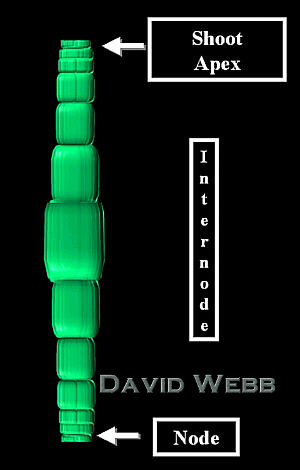
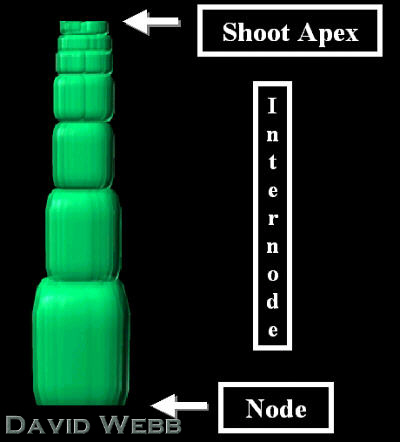
This image illustrates the Intercalary Growth which occurs in one cell file. New cells are produced at the Shoot Apical Meristem. These divide for some time. Cells in the middle of the file differentiate first. Cells at the Node continue to divide
for some time. They constitute the |
|
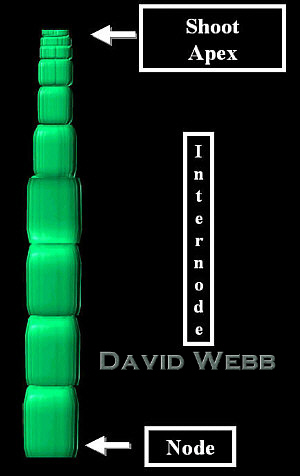
This Image is the same as above but it represents many cell files. This would be extremely awkward and dangerously weak if the cells retained this morphology after they have matured. Once the meristematic activity of the cells in the Intercalary meristem ceases, they enlarge and form a columnar Internodal. |
|
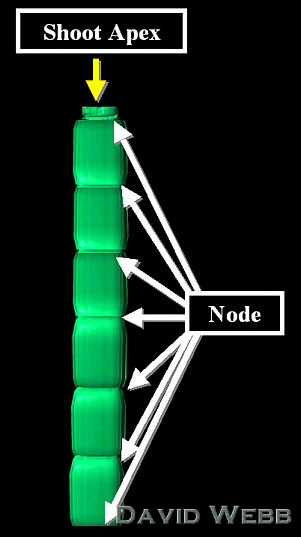
The Intercalary Meristem has ceased dividing and its cells have differentiated. This produces a columnar Internode in which the cells at the base of the Internode are no wider than those above it. |
|
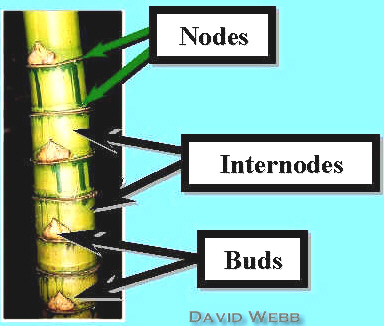
A Stem that is produced by Intercalary Growth has a uniform diameter from the base to the Shoot Tip and can have a "Jointed" appearance, like Bamboo!!!!! |
|
 |
| Equisetum is a seedless plant
which has Intercalary Growth. Its stems are distinctly jointed and are easily separated at
the Nodes, as these represent points of weakness. Why are they weak?
The plant below has produced a terminal cone. Locate the Leaves, then the Node for this terminal stem segment!!! |
|
|
|
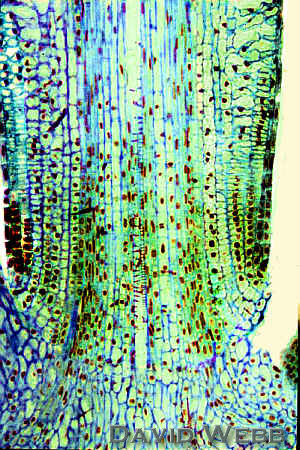
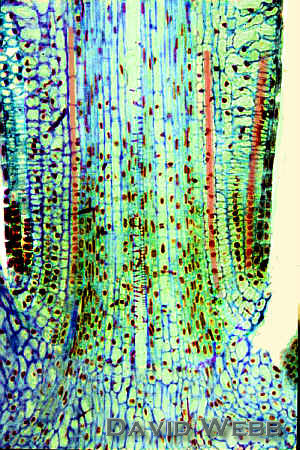
Examine the Long Sections of Equisetum Stem below. A Node is located at the bottom of each Image.
Note the differences in cell size along the red lines in the left-hand image.
Note that the cells get smaller towards the Node. This could not occur in a stem with Apical Growth.
 |
 |
Prior Page |
 Top |
Next Page |