|
 Prior Page |
 Next Page |
|
Prior Page |
Next Page |
Nodes - Internodes |
|
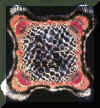
Leaves are tightly coiled around the shoot apical meristem. It may be possible to point to individual nodes, but there is little internodal elongation near the SAM.
|
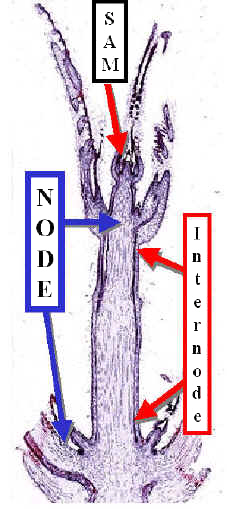
As leaf primordia become displaced
from the SAM, internodal elongation begins. 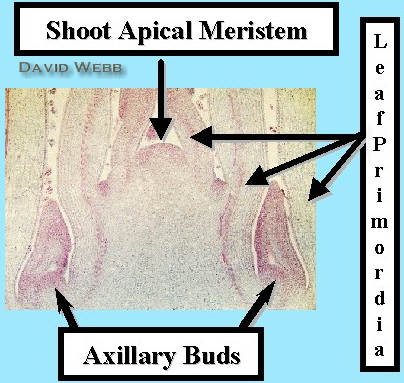 Shoot Apex of Forsythia. Leaves are attached at the Nodes. Some internodal elongation is apparent in this shoot tip. Note the Axillary Buds which also occur at the Nodes. |
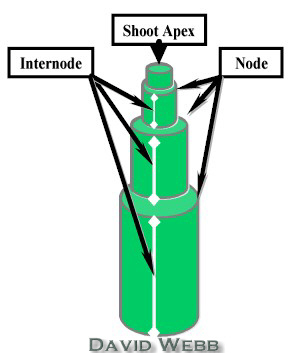
Elongation is sequential and resembles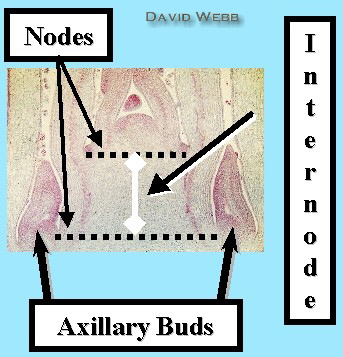 an old monocular telescope (spy
glass) with the shortest and most slender segments at one end and the longest,
widest segments at the opposite end. an old monocular telescope (spy
glass) with the shortest and most slender segments at one end and the longest,
widest segments at the opposite end. |
Stem elongation causes a separation of the leaves along the stem axis. Internodal growth is determinate, and ceases after a prescribed period. Elongation can be infludnced by a number of environmental factors including light, wind, nutrition and water availability. The nodes generally produce axillary buds which can become branches. Furthermore, root primordia may be present, especially with monocots like bamboo. |
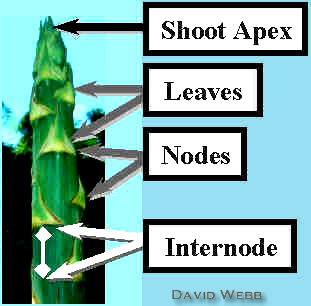
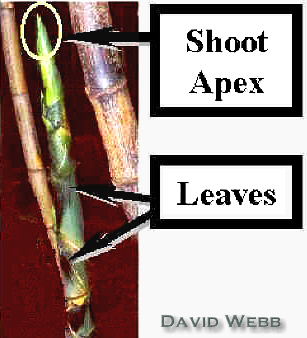
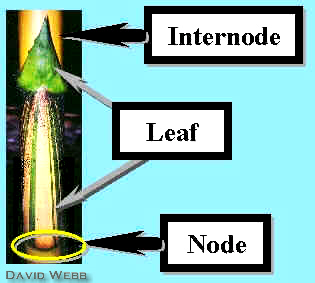
In Bamboo, the leaves are tightly appressed to the stem and encircle it at their base. It is difficult to point out nodes as the leaves also overlap one another near the stem tip. As the Internodes elongate it becomes possible to
|
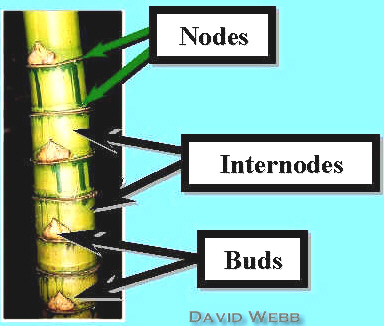
This photo shows the disposition of
the leaves,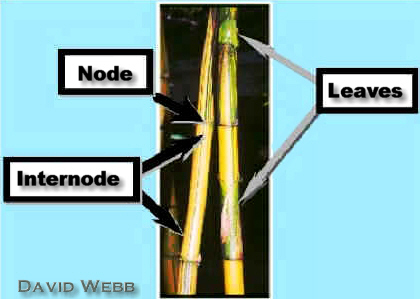 nodes and internodes.
The leaf from the preceeding image is seen at the top of the right stem. The leaf just
node below it is split longitudinally on one side, and encircles the stem at the
node. nodes and internodes.
The leaf from the preceeding image is seen at the top of the right stem. The leaf just
node below it is split longitudinally on one side, and encircles the stem at the
node. The leaves are ephemeral and fall away as the stem
matures. This clearly reveals the internodes. There was far less internodal elongation with the adjacent stem. Note the buds which occur at each node.
|
|
Prior Page |
 Top |
Next Page |