The
Seed-6
The
Seed-6 

Cereal Seeds
Cereals like Rice, Wheat and Corn are the nutritional foundations of Civilizations! They are worth more than their weight in Gold. The Eagle on the Great Seal of the United States holds shafts of wheat in one of its talons. This signifies the importance of agriculture in the foundations of our country. It is ironic that in this time of prosperity, the American farmer is loosing his/her land. It is also sadly ironic that millions of children suffer and die from starvation while the world has the means to produce enough food for all. I am waiting for "the day when the world gets round" (G. Harrison). I hope it comes soon!!!!!!!
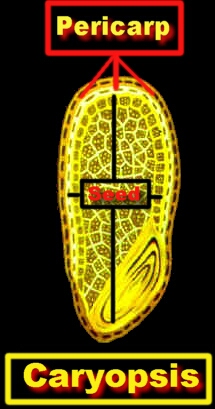
Corn and wheat "seeds" are actually dry fruits in which the Pericarp and the Seed Coat (Testa) are fused. However, because they are largely composed of a seed, and because of their unique anatomy &importance, we will study them like true seeds.
 You will doubtless remember that the corn cob is an inflorescence composed of Carpellate Flowers. |
 Cross-Section of a Corn Cob: The Corn Kernels are actually Fruits(F). The Cob is the Receptacle (R). |
 |
 |
| Diagram of a Cereal Caryopsis: The Seed is largely composed of a Starch-rich Endosperm. The Embryo is prominent as well. | |
 |
 |
| Wheat Caryopsis: The Cells of the Endosperm are Moribund while the cells of the Aleurone layer are physiologically active. During germination the Aleurone cells secrete enzymes which digest the Endosperm. Endosperm metabolites are absorbed by the Embryo. | |
 |
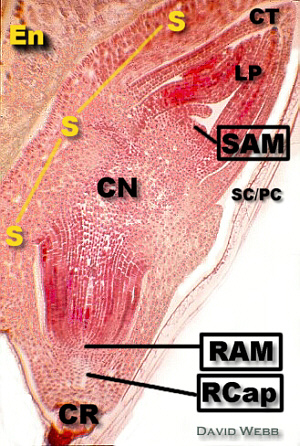 |
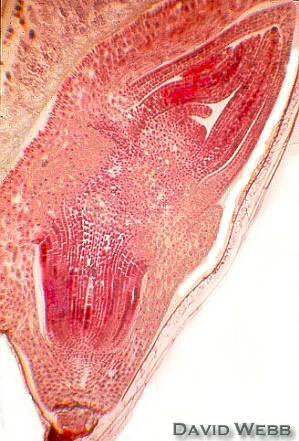
| The wheat Embryo & its immediate Environs: En = Endosperm, S = Scutellum (Cotyledon) CN = Cotyledonary Node, RAM = Root Apical Meristem, RCap = Root Cap, CR = Coleorhiza, SC/PC = Seed Coat/Pericarp, SAM = Shoot Apical Meristem, LP = Leaf Primordia, CT = Coleoptile | |
 |
 |
| The Endosperm of cereals has two major
regions. The outer part is called the Aleurone Layer. Its cells of have prominent Nuclei. They contain most of the oil
extracted from corn. They also contain a relatively large amount of Protein
in the form of "Aleurone Grains". Cells of the
underlying Endosperm contain many Amyloplasts
which store Starch. The diffuse blue areas in these cells
represent diffuse storage proteins called Glutens (G). The Aleurone is removed to make White Rice. Consequently, most of the proteins and essential oils are removed. The same is true for white bread. |
|
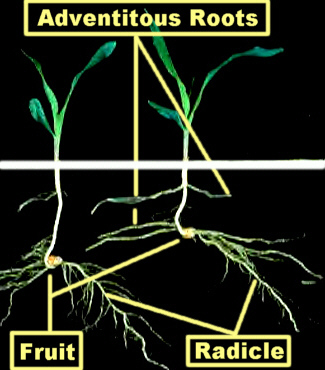
The Coleoptile which protects the Leaf Primordia and the SAM breaks through the Caryopsis and remains closed until it penetrates the soil. The Foliage Leaves emerge through a slit that develops in the Coleoptile.
Thus type of Germination is called Hypogeous (Under Ground) because the Cotyledon (Scutellum.) remains under-ground.
Germination like that seen with Bean (Phaseolus) is called Epigeous because the Cotyledons are pulled above-ground during Germination |
|