 The
Seed-5
The
Seed-5 

Castorbean (Ricinis)
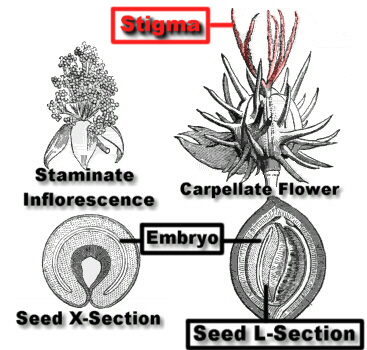
The Castorbean or Castor Oil plant belongs to the Euphorbiaceae which is one of the most numerous and important plant families. Its seed is typically used in Botany classes because it has a large Endosperm at maturity. Such seeds are called Albuminous. Seeds which lack a significant Endosperm are called Exalbuminous! The Seed develops from a Carpellate Flower. The plants are monoecious and bear Staminate & Carpellate Flowers in the same Inflorescence.
The seed contains Ricin which is one of the most toxic proteins on the planet. Consequently, it would not be a good idea to serve a salad topped with Castorbeans! This is only done by the CIA which had a program that looked into Ricin as a way to kill spies and other undesirables. The toxin can't pass through the Seed Coat. However, you should wash your hands after handling these plants.
The Endosperm is rich in Lipids which are a high yield storage product. Castor Oil is derived from these seeds.
The Embryo produces large but extremely thin Cotyledons. These metabolize storage products from the Endosperm during Germination!
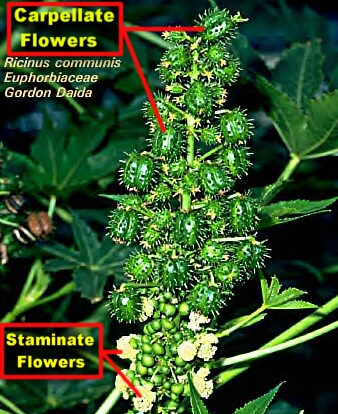 Ricinis communis Inflorescence: Staminate Flowers are located at the base of the inflorescence and open first. Carpellate Flowers are located on the upper part of the inflorescence. |
 Ricinis communis Inflorescence: The Carpellate Flowers have large showy stigmas while the Staminate Flowers have many light yellow stamens. |
 |
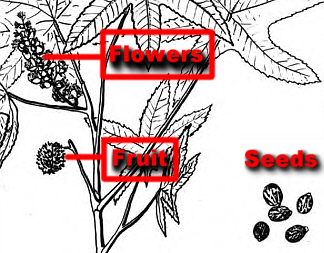 |
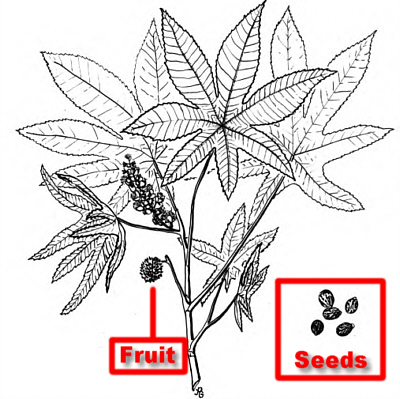
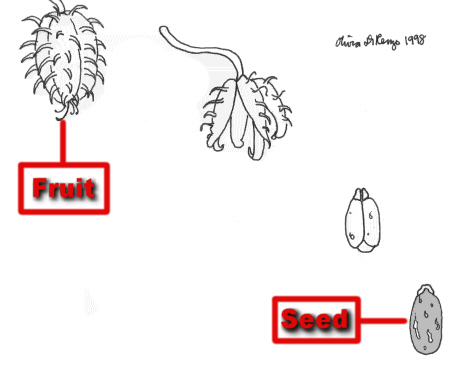
| Diagrams of Ricinis showing details of the Fruits and Seeds. What type of fruit do you think they have? | |
 |
 |
 Castorbean Seeds |
 Diagram of a Cross Section from a Ricinis Seed: note the large Endosperm (En) and the relatively thin Cotyledons of the embryo (E). |
