 The
Seed-4
The
Seed-4 

Seed of Bean (Phaseolus sp.)
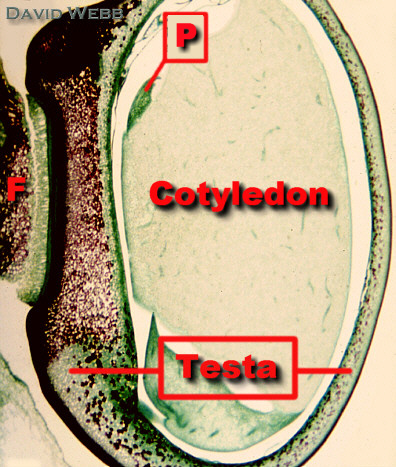 Longitudinal Section through a Bean (Phaseolus) Seed: Note the Funiculus (F) which attaches the Ovule (a.k.a. the Seed) to the Placenta. The Cotyledons fill most of the seed's volume. Fragments of the Endosperm may occur between the Cotyledons and the Testa. |
 Diagram of a typical Legume Seed: The Plumule represents the "Bud" or Shoot Tip of the Embryo. The Epicotyl includes the Plumule and any other stem tissue above the Hypocotyl. |
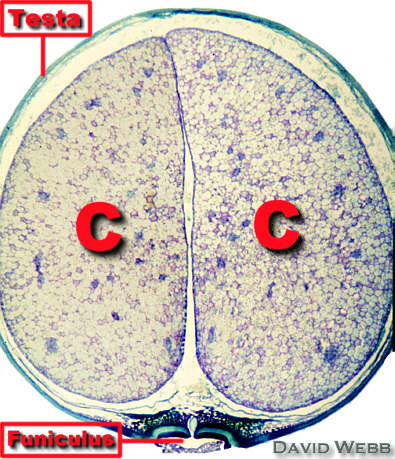 Cross-Section of a Bean Seed above the level of the Plumule: The Cotyledons are the only visible Structures. |
 Cross-Section of a Bean Seed through the middle of the Embryonic Axis which lies close to the Funiculus. The Axis consists of everything from the SAM to the RAM |
 Cotyledons may contain large quantities of Starch which has stained brown with IKI. Phaeolus Cotyledons contain a lot of starch. |
 In some cases like Soybean (Glycine max) the Cotyledons contain large amounts of Protein in Protein Vacuoles (Blue). This is the reason why Soybean is such an important crop. |
 High Magnification View of the Funiculus: Note the presence of the Tracheid Bar (T) near the opening (Hilum) in the Testa. Note the Aerenchyma which surrounds the tracheids. These probably assist in the uptake of air and water. There are two Palisade (P) layers composed of Macrosclereids. One of these develops from the Funiculus. |
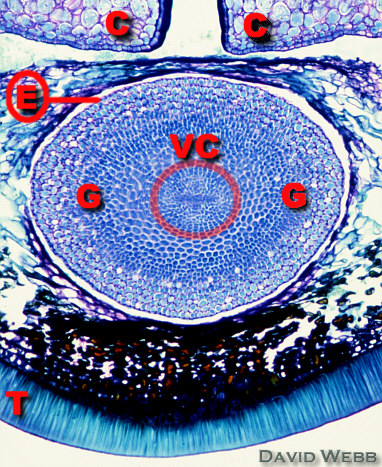 The Embryonic Axis is composed of a central Vascular Cylinder (VC) which is Diarch. This suggests that it is the region of the Root. The Vascular Cylinder is surrounded by Ground Tissue (G) and a unicellular Epidermis (E). One layer of Macrosclereids is clearly visible in the Testa (T) |
 Macrosclereids, Osteosclereids and Brachysclereids are commonly found in Seed Coats. |
|
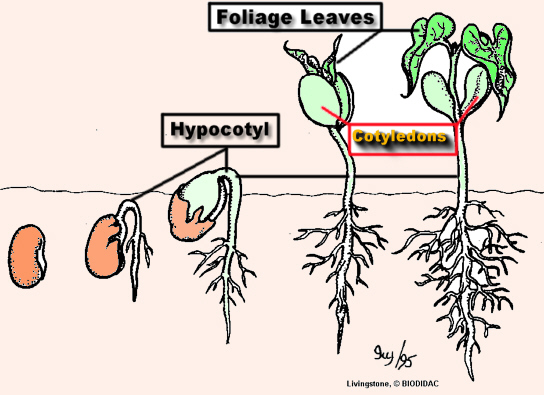 During Germination the Root is the first organ to emerge and forms a Taproot System. The Hypocotyl elongates and drags the swollen Cotyledons above the ground.
This type of Germination is called Epigeous (Above Ground) because the Cotyledons are pulled above ground during germination. Pea (Pisum) has Hypogeous (Below Ground) Germination because the Cotyledons remain below-ground during germination.
The Hypocotyl continues to elongate and becomes erect. The first leaves expand and the first internode elongates. The SAM is activated and produces the shoot system. |
|
