|
|
Grass
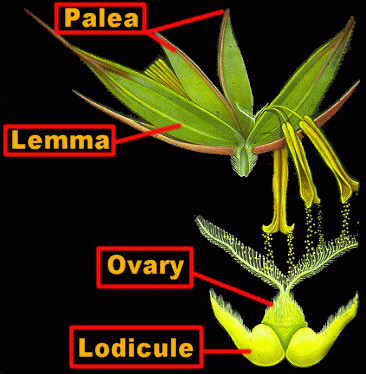
Flowers called a Florets & they
are enclosed by two bracts called the Plaea and Lemma (Lower Bract). The Lemma encloses the Palea and the Flower Organs. Florets occur in groups called Spikelets. Each Spikelet is
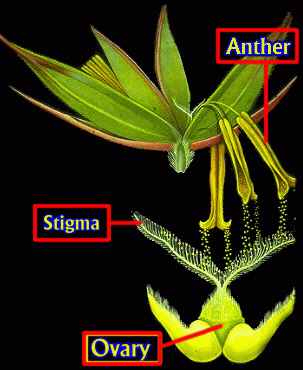
subtended by bracts called Glumes. The Perianth of each Floret is represented by two transparent scales called Lodicules. There are generally 3 Stamens and a Syncarpous Gynoecium with two hairy Stigmatic lobes. The Stigmatic trichomes are disgned to capture wind-borne Pollen |
|
 Diagram of a Grass Flower |
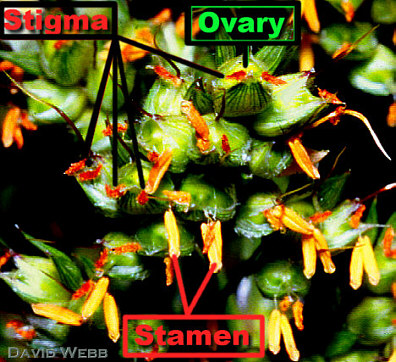 Mystery Grass with Incomplete, Perfect Flowers |
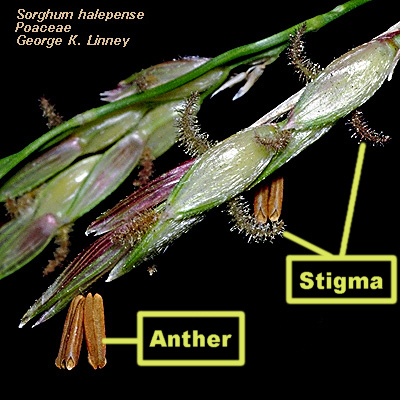 Sorghum Inflorescence |
 |
 |
 |
| Corn (Zea mays) is Monoecious. The tassel is composed of Staminate Flowers while the ear contains Carpellate Flowers. The filaments of corn silk are Styles. The corn Pollen Tube has to travel the length of the style to reach the egg. | |
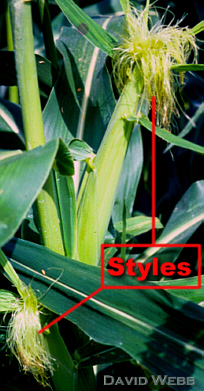 Carpellate Inflorescence of Corn |
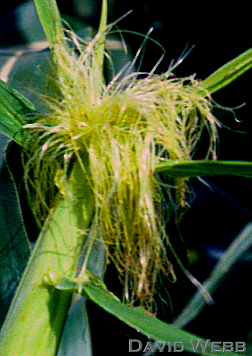 Corn Silk (Styles) |
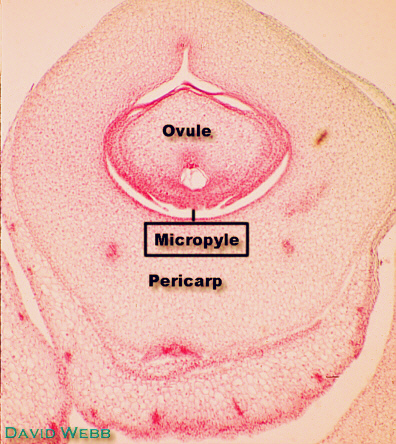 Cross Section of an Immature Corn Ovary: Note the General features of the Ovary. |
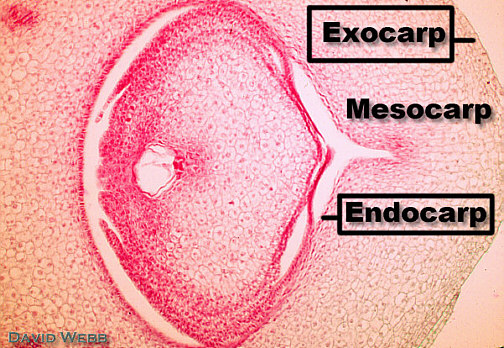 Cross Section of an Immature Corn Ovary: Note the Lyaers in the Pericarp. 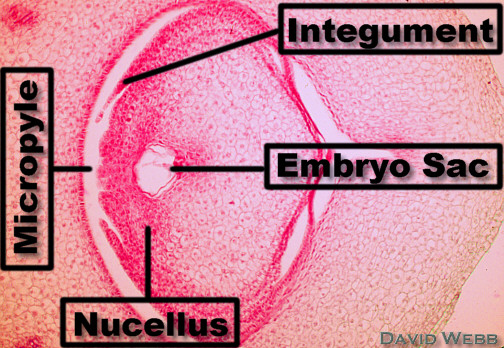 Note the Major Components of the Ovule |