Rhodophyta-5
  Rhodophyta-5
Size Range = Microscopic to several meters in length.
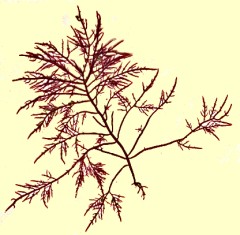 Gelidium |
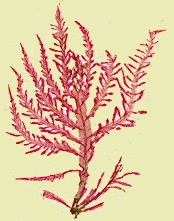 Delessaria sp. |
|
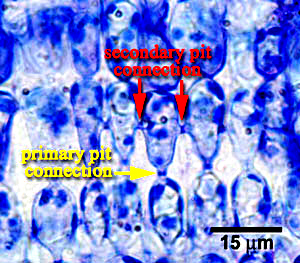
| Primary & Secondary Pit Connections |
Similar pit connections form between host and parasite red algae.
They have Apical Cells.
Each Filament has its individual Apical Cell. This is fundamentally different from Apical Cells in land plants.
The Apical Cell in land plants produces all of the cells in that organ. This includes many longitudinal cell files that are joined at inception. This can result in flat thalli like thallose liverworts or fern gametophytes.
Adjacent cell files in the
Rhodophyta can fuse. This produces a thallus that resembles
the tissues we have seen in land plants but it is not the same because adjacent cells are
derived from different Apical Cells & are not united at inception.
This produces a thallus that resembles
the tissues we have seen in land plants but it is not the same because adjacent cells are
derived from different Apical Cells & are not united at inception.
The type of cell fusion that occurs in the Rhodophyta is called "postgenital" (post genesis).
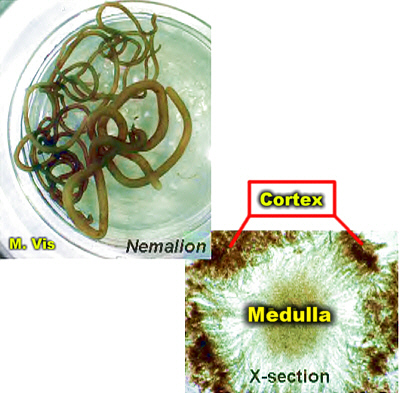
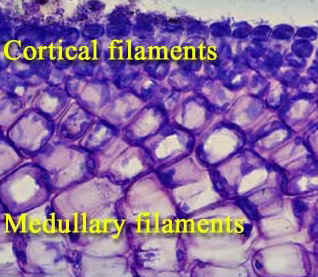 Cross Section through an Axis showing the more central Medullary Filaments and the smaller, peripheral Cortical Filaments. |
In some cases there is an "Epidermal" Layer. However, this is not a true Epidermis.
Growth can be Uniaxial or Multiaxial
When one Filament comprises the main axis it is Uniaxial.
When there are numerous axial Filaments is it is called Multiaxial.
Each Filament is produced by an Apical Cell.
These comprise the central Medulla.
The Medullary Filaments branch subapically and produce the Cortical Filaments.