|
Primary vs Secondary Growth-5 |
 |
| Periderm
is produced by the other lateral meristem in plants. This
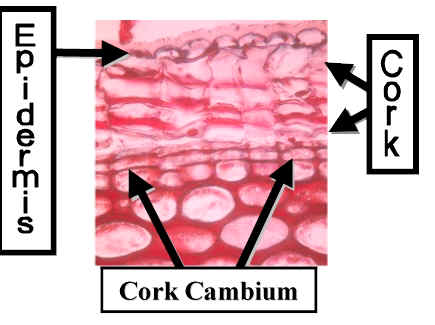
meristem is called the Cork Cambium
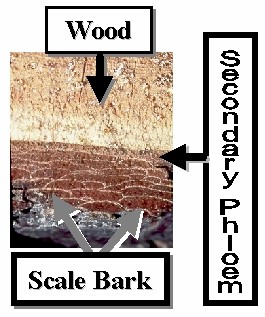
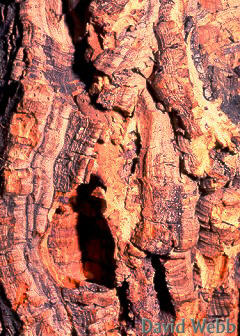
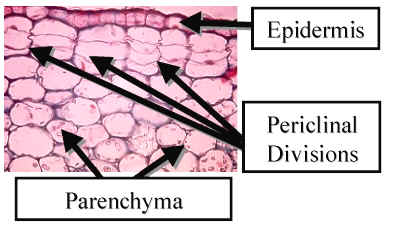
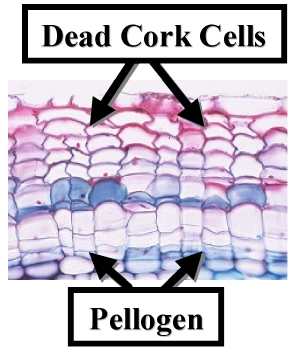
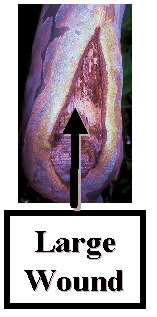
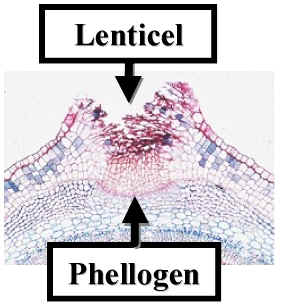
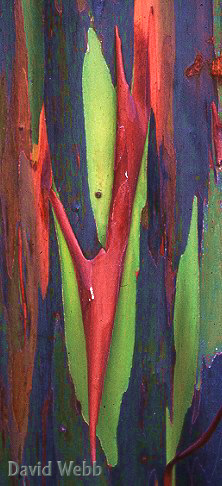
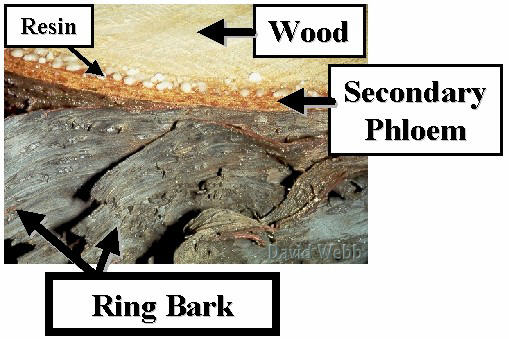
or Phellogen. The Phellogen produces Phellem or Cork. Unlike the Vascular Cambium which is a continuation of another meristematic tissue, the Cork Cambium arises de novo from non-dividing parenchyma cells. Phellogen usually arises in the outer Cortex, close to the Epidermis. Periclinal divisions by a group of subepidermal cells is the first step in Periderm formation. The Phellogen continues to divide Periclinally to produce radial rows of cells. Hey this sounds familiar! However, Cells are produced only towards the outside, unlike the Vascular Cambium which produces cells in two directions. Cork cells deposit Suberin in their cell walls. Lignin may also be present. Suberin is water-proof. Consequently, cork cells prevent evaporation from the more internal tissues. Local areas of mitotic hyperactivity produce Lenticils which allow air to enter the organ. Suberin and lignin are hard to digest by microbes and act as a barrier to pathogens. Periderm heals severe wounds caused by physical trauma or pathogens. Cork cells are dead at maturity and they replace the Epidermis as the outer boundary of the stem or root. The suberized-lignified Cork Cell walls retain their shape. The air inside them acts like an insulator. Before the advent of Styrofoam cork was extensively used as an insulator. Plants can't generate heat. Consequently, insulation by cork could be an important adaptation in ecosystems which experience freezing weather. Furthermore, Cork protects stems from fire! Fire is an important ecological factor for large areas of the planet. Periderm is typically produced by woody stems and the roots of woody plants. However, herbaceous stems may also produce some cork. Tree Bark is largely composed of Cork. There are basically two types of Bark. When large sheets of bark exfoliate from the stem we call it "Ring Bark". Paper birch is the best example of this. When scale-like pieces are
produced we have a "Scale Bark". |
|
|
|