 Plant Cell Walls - 13

311 Syllabus
Plant Cell Walls - 13
| This cartoon tries to illustrate how Cellulose Fibrils and Matrix Components are synthesized at the Plasmalemma. The cream colored Boogie Board represents the lower half of the Plasmalemma. The Rosettes synthesize new Cellulose Molecules which become oriented parallel to the Microtubules just beneath them in the Plasmalemma. The Cellulose Microfibrils lay on the outside of the Plasmalemma, NOT in the Middle. |
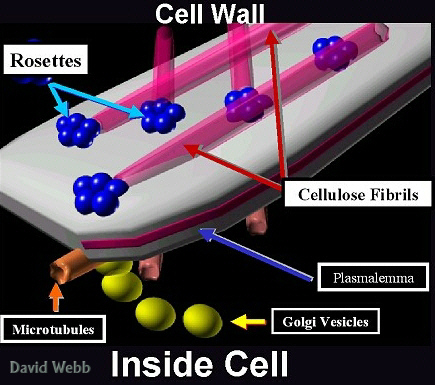 |
| Matrix components arrive in Golgi Vesicles which fuse with the Plasmalemma and release their contents into the Wall area. |
Bind to Cellulose Microfibrils &
Link Microfibrils
Xyloglucan (Glucose & Xylose)
Cellulose Backbone with Side Branches
Composition = Acidic Sugars & Neutral Sugars (Galacturonic Acid & Rhamnose)
to form molecules like RhamnogalacturonanThey have Long Backbones with Side Chains.
Their Carboxyl Groups have a Neg. Charge and are linked by Ca++
They also have some stable Covalent Linkages.
They may be linked to the Structural Proteins in the Matrix.
There are Several Types with Different Major Amino Acids
They have highly Repetitive Structures
They are initially Soluble but more Insoluble proteins are produced as the wall matures or upon wounding.
Wounding -> Increased concentration of Proteins.
Characteristic Proteins found in different types of Tissues
Protect from Wounding & Desiccation
Provide Wall Strengthening
Provide Nucleating sites for Lignin
Similar to those in certain Chlorophyta
Water Soluble
Cell Signaling & Differentiation
