Shoot Apical
Meristem (SAM)
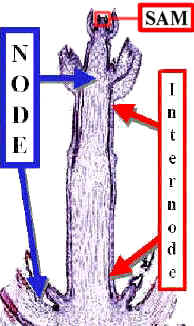
Occurs at the Summit of
the Stem
Overtopped by Developing
Leaves
Produces
Primary Stem
Secondary Stems &
Leaves
Node = Locus on the stem where a leaf is attached.
Internode = Segment of stem between two Nodes.
 |
 |
| SEM image of a Shoot Apex: The Leaf
Primordia (LP) cover the Meristem Proper. |
SEM image of a Shoot Apex with most leaf
Primordia removed: The Meristem Proper is the small bulge indicated by the arrow. Note the
progression of Leaf Primoordia in terms of their relative size. |
 |
 |
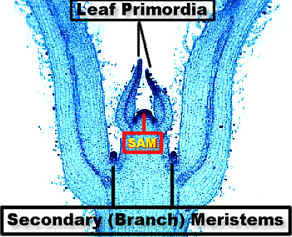
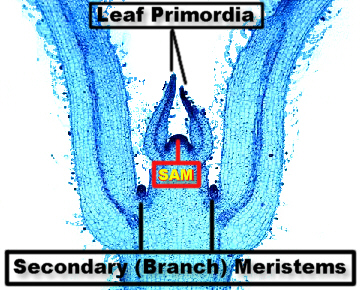
Long section of a Coleus
Shoot Apex: SAM = Meristem Proper. Note the origin of Secondary Branches in the Axils of
the young Leaves
|
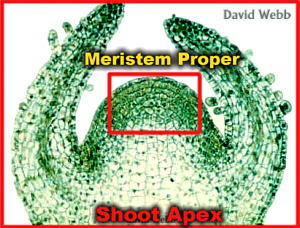
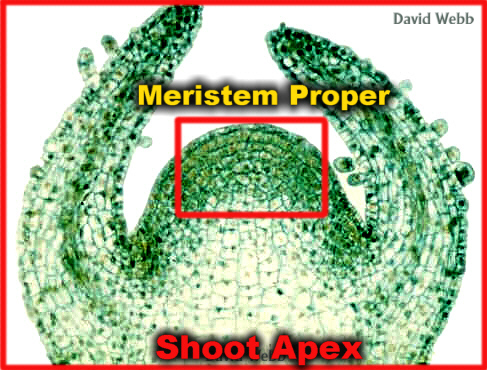
Coleus SAM: The entire image
represents the Shoot Apex. The red box selimits the Meristem Proper
|
Meristem Proper
Above the zone of Leaf
Primordia
Summit of the Stem with
Meristematic Cells
Meristematic
Cells 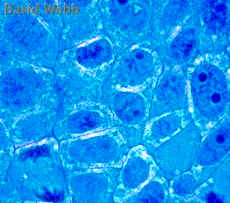
Isodiametric,
Thin Walls
Dense Cytoplasm
Large Nucleus
Microscopic Vacuoles
Shoot Apex
= Meristem Proper & Leaf Primordia
Shoot Apical
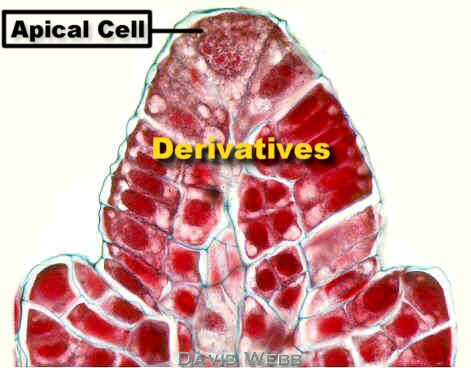
Meristems of Seedless Plants have Apical Cells
No Root Cap-like structure
is produced.
All cells in the stem can
be traced back to the Apical Cell.
Apical Cell divides
Infrequently
Derivatives divide rapidly
then Differentiate.
Shoot Apical Meristems of
Seed Plants are Multicellular
There are no obvious
initials like those we saw for some roots!
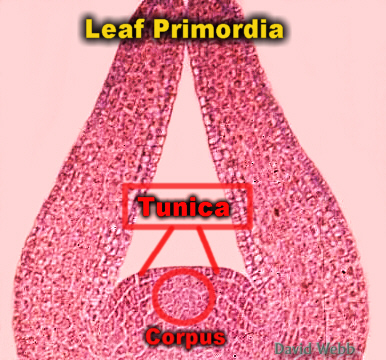
Tunica Corpus Organization
Tunica Layers
The Surface Layer only divides
Anticlinally (perpendicular to the surface).
This is called a Tunica
Layer due to its pattern of Cell Divisions
This produces a single layer of
cells which forms the Epidermis for all seed plants.
Subepidermal layers
may also divide in the same manner.
Consequently, there may be 2-3
Tunica Layers.
Corpus
The Tunica is like a dome which
sits on a spherical zone of cells (Corpus) in which the planes of cell
division are NOT strictly ordered.
Most Organs arise in the outer
2-3 cell layers and always include the outermost Tunica Layer. The Corpus may or may not
contribute directly to Secondary Stems or Leaves.
Cytohistological
Zonation &
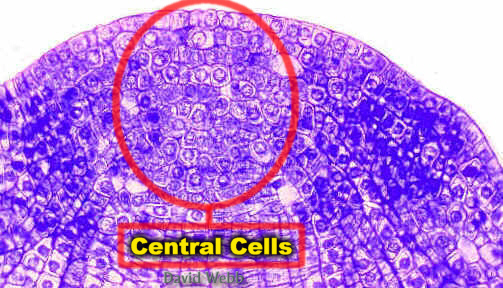
Central Cells
Groups of
Cells may be separated based on their Cytological
Traits.
Cells in the center
of the Tunica & Corpus
Enlarged
Divide Infrequently
Have noticable Vacuoles
Stain lightly with
Cytoplasmic stains.
These have been called Central
Cells.
Comparable to the Quiescent
Center in Root Apical Meristems.
Peripheral
Zone (PZ)
Cells just beneath the
Central Cells
Divide Rapidly (like
the Apical Cell Derivatives)
Rib
Meristem
Anticlinal
Divisions
Long vertical Cell Files
Becomes the Cortex.
Dave Webb's
simplified view of SAM organization.
The SAM is just like the
RAM in that both have a Quiescent Center surrounded by rapidly dividing cells.

 Meristems-5


 of SAM organization.