|
||
|
||
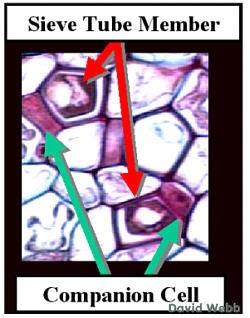
Companion Cells also occur in dicots. However, they are not always easy to identify
because Phloem also contains Parenchyma cells of various
dimensions, and these can make it hard to locate Companion
Cells. The small Companion Cells are easy to find in the
images on the left and above, because of their small size, and clear association with
STMs. cells of various
dimensions, and these can make it hard to locate Companion
Cells. The small Companion Cells are easy to find in the
images on the left and above, because of their small size, and clear association with
STMs. |
||
Sieve Tube Members
& Sieve Cells produce a carbohydrate called Callose.
Callose lines the Sieve Pores and also occurs |
||
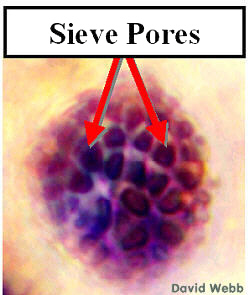 |
High magnification view of a Sieve Plate from the specimen above. Callose is clogging the Sieve Pores. |
|
 |
Sieve Plates (SPLs) in a prepared specimen - Callose also lines the margins of the Sieve Pores, just outside the Plasmalemma. Increased callose deposition can also block the SPLs. This can happen seasonally and is reversible. Thus, plants can regulate phloem transport based on seasonal environmental stimuli as well as traumatic stimuli. |
|
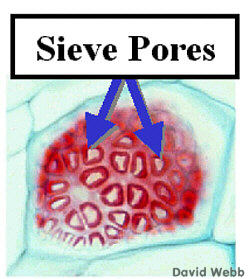 |
Transverse (Surface) view of a Sieve Plate from a prepared slide. Note the size of the Sieve Pores. |
|
 |
Home Page |  |
|---|---|---|