Basic Leaf Terminology - Monocots & Ferns

Prior Page

Lecture Directory

Next Page

l66lily.jpg (38746 bytes)
Lily with Parallel (Longitudinal Striate) Venation

Orch200.jpg (20289 bytes)
Terrestrial Orchid with Parallel (Longitudinal Striate) Venation

tilef-1-300Crop.jpg (35135 bytes)ParallelTiClose.jpg (28416 bytes)comisuralBund.jpg (11739 bytes)
Ti (Cordyline terminalis) Leaf with Parallel (Longitudinal Striate) Venation. Commisural Bundles are apparent in the picture furthest to the Right. The Commisural Bundles provide a network of lateral veins which interconnect the longitudinal veins.

 TravelerPalm300.jpg (43159 bytes)
Travelers' Palm
a monocot with a Large Simple Leaf - Its leaf partitions are caused by the wind. Much the same occurs with banana (Musa).

ParVeinWhoMont.jpg (108152 bytes)
Parallel (Longitudinal Striate) Venation in the leaf of Strelitzia (Bird of Paradise).The cross-hatch pattern is caused by the Commisural Bundles.

PrayerPlant300.jpg (40632 bytes)          ComisComposLab.jpg (28467 bytes)
Commisural Bundles are very abundant & prominent in the leaf of Maranta (Prayer Plant)

The prayer plant (Maranta), Ti & Traveler's Palm exhibit several vein traits which point out the limitations of the generalization that Monocots have only Parallel Venation.

All of them have Commisural Bundles which results in a close-knit pattern that rivals the contact between veins and the mesophyll seen with Reticulate Venation.

Furthermore, Ti and Maranta have apparent "Midribs" and there are "lateral" veins which diverge from it in a pinnate-like pattern (Maranta). These midribs do not contain extremely enlarged veins but they contain a concentration of parallel veins.
Finally, the veins converge and join near the leaf margin forming a closed, integrated vascular system. The pattern seen in Maranta is called Pinnate-Striate.

The term Striate is preferable to Parallel when Venation in Monocots is considered. Grasses have Longitudinal Striate Veins.

TIMribLab300.jpg (38159 bytes)
Cross-section of ti Midrib showing the many Vascular Bundles it contains

AnthuriumParadermalVenation400.jpg (55298 bytes)
This is a Paradermal Section which shows the minor veins in Anthurium. The pattern is identical to Reticulate Venation in Dicots.

AnthuriumX-S400.jpg (34120 bytes)
Cross-section of Anthurium Leaf
Note the Palisade & Spongy Mesophyll which resembles that seen with some Dicots.

Monstera240.jpg (42024 bytes)
Monstera 
LeafAn3.jpg (21217 bytes)
Taro
More monocot leaves that have Pinnate Striate Venation!

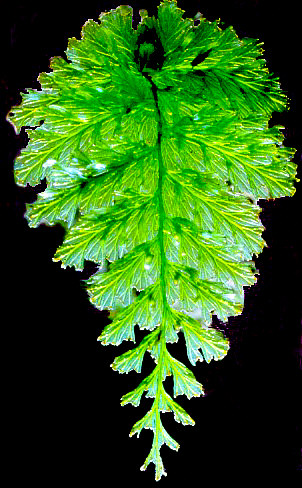
Dichotomous VenationFilmyFernSharp300.jpg (85321 bytes) consists of veins which fork at their apex and produce 2 veins of the same size. The branches can develop equally or unequally. The minor veins tend to be of the same size rather than getting progressively smaller. The terminal Veins may end "Blindly" near the margins of the leaf. Dichotomous Venation occurs with "Ancestral" plants which arose before the Flowering Plants. It is sometimes called "Primitive" because it is not as efficient as Reticulate Venation & not observed in Flowering Plants..

Prior Page

Lecture Directory

Top

Next Page