|
Flowers & Fruits-1
|
 |
The Vegetative Organs are the Root, Stem and Leaf. The flower contains various Organs.
Floral organs are modified leaves! They are formed at the shoot apex in the same manner as other leaves, and some floral parts like sepals and petals may be clearly leaf-like in their morphology.
Most Stamens and Carpels are not "leafy" in their appearance. However, some plants produce leaf-like Stamens and Carpels. Furthermore, careful anatomical studies have shown that these floral organsare highly modified leaves.

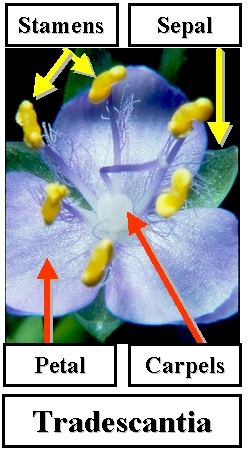
The Sepals constitute the Calyx
The
Petals comprise the Corolla
The Sepals and Petals are collectively called the Perianth.
When the Sepals & Petals are identical, they are both called Tepals
Stamens comprise the Androecium (Male House)
Carpels comprise the Gynoecium (Female House).
The morphological unit of the Gynoecium is the Carpel.
The term Pistil has been used in the past to describe the gynoecium and this can cause some confusion in terminology.
A Gynoecium of a flower may contain 1 carpel, 2 carpels or n Carpels.
The Carpels may be free (Apocarpous) or united (Syncarpous)
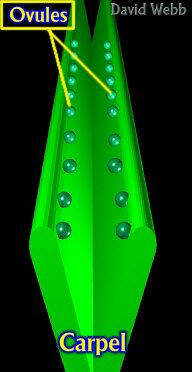
A] Model of a Primitive Carpel with Ovules distributed at the Margin of the Leaf
|
C] Model of a Primitive Carpel which has become folded but the Ovules are still marginal
|
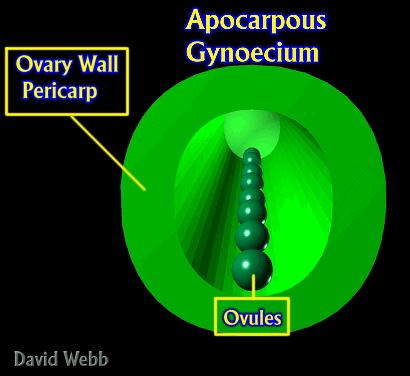 E] Cross Section of a Simple Carpel: Some Gynoecia contain one Simple Carpel.
|