|
|
| Secondary
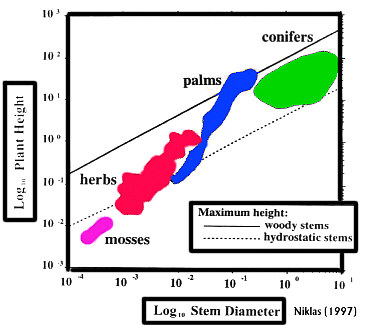
Growth results in a continual increase in diameter. It was a necessary
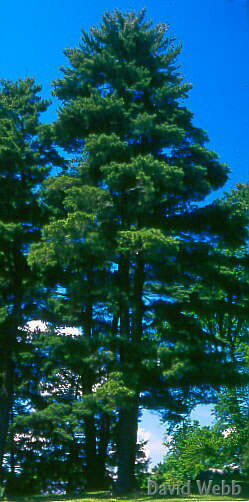
adaptation for plants to reach great heights. Tree Ferns are arborescent (tree-like) but they grow very slowly, and their stem diameter is similar from top to bottom. Furthermore, they do not grow as tall as large Conifer or Angiosperm trees. Plants that can grow to great heights can overtop other plants and acquire optimal levels of sunlight. This is an obvious advantage for survival.
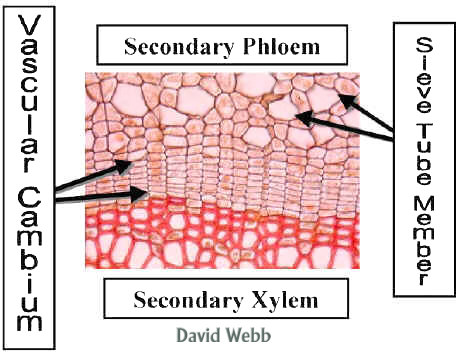
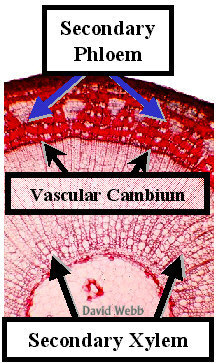
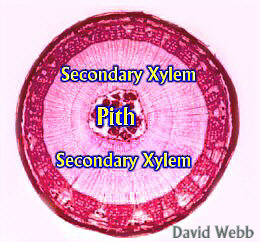
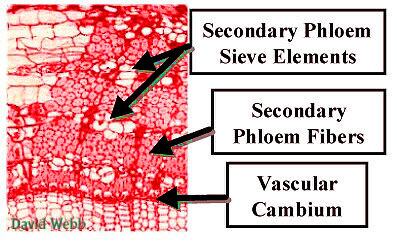
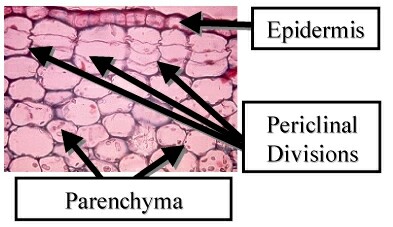
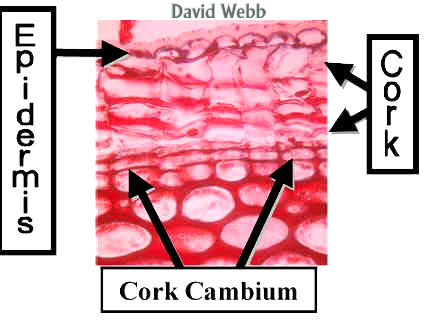
Furthermore, taller plants also distribute their spores over a greater distance. This has obvious reproductive significance! The Vascular Cambium produces Secondary Xylem and Phloem. Secondary Xylem accumulates because it contains thick walled cells which retain their shape under pressure. Secondary Xylem is commonly called wood. Secondary Phloem may contain thick-walled fibers. In this case, the active phloem may persist over several seasons. Otherwise the functional Secondary Phloem is located near the Vascular Cambium. The outermost Secondary Phloem is converted into Periderm in many large trees. A dynamic equilibrium is established with the Vascular Cambium which produces new phloem while old phloem is converted into Periderm. Secondary vascular tissues provide vertical continuity over long distances in stems and roots. This is necessary for the efficient movement of water and carbohydrates throughout large plants. The production of Secondary Phloem and Xylem evolved independently several times during the course of evolution. Fossil Lycopods and Sphenopods contain secondary vascular tissues. However, with a few minor exceptions, Secondary Vascular Tissues are characteristic for Coniferophyta. & Anthophyta while the other divisions we studied, only exhibit Primary Growth. The other Secondary Tissue is Periderm. Periderm forms an impervious barrier between the outer environment and internal plant cells. Without Periderm, plants with secondary vascular tissues would develop cracks as their diameters increased. That would expose internal cells to environmental insults, like heat, cold or desiccation, and pathogen attacks. Consequently, Periderm is a very important adaptation. |
The occurrence of Periderm in extant Divisions is similar to that for Vascular Cambium. |