|
 |
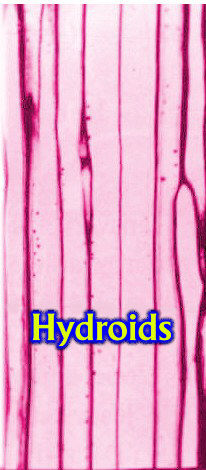
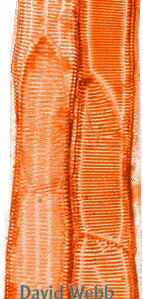
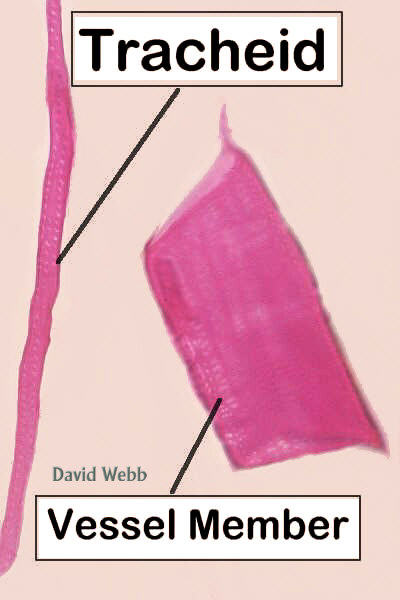
Xylem has the dual function of providing structural support and water conduction. These two are compatible because it is important to have a rigid tube for vertical water transport & for structural support.In the bad old days, straws were made from waxed paper. They worked well at first but when the wall of the straw started to get soft, they ceased to function. If you sucked hard, the straw collapsed! Plastic straws last much longer because they are more rigid, and they are waterproof. However, if you stick a plastic straw in soft ice cream it will collapse before the ice cream gets to your mouth. If you had a steel straw and applied enough suction, the soft ice cream would reach your lips. Consequently, any straw must be rigid enough to withstand the suction required to move a fluid in any direction. In order for plant cells to be good straws they need to have strong rigid cell walls that won't collapse under tension. Furthermore, the wider the straw, the greater the volume moved. The volume moved is proportional to the fourth power of the diameter! Thus a wide straw is far, far better than a narrow one. Xylem cell walls are thick & lignified. Remember that lignin imparts strength and waterproofing to cell walls. Lignified walls will stand up to greater suction than unlignified walls. Lignified walls are also like the solid wall of a plastic straw. Consequently, they are well suited to provide for water transport and structural support. The term Tracheary Element is used to describe the specialized cells that are designed for water transport. The Hydroids of Bryophyta might qualify as tracheary elements, although, their walls are usually thin and unlignified. However, water moves through them faster than other cells. They are thus analogous (Similar) to tracheary elements but may not be homologous (Same) to them. Vascular Plants have two types of Tracheary Elements, Tracheids & Vessel Members. Tracheids provide good structural support and fair water conduction. Vessel Members provide superior transport but inferior support. They have large openings in their end walls called Perforation Plates. These allow for better water flow vertically. Vessel Members are characteristic for the Magnoliophyta and are regarded as advanced compared to Tracheids which are preset in virtually all other vascular plants. However, members of the Magnolia family (Magnoliaceae) do not have Vessel Members. Their floral structures are "primitive" as well. Consequently, this family is regarded as Ancestral or Primitive compared to most families of flowering plants. Vessel Members are easy to spot in wood. They appear to be holes or pores in cross-section because of their large diameters. However, Tracheids & Fibers may also be present in the xylem of Magnoliophytes who thus, get the best of both Tracheary Elements. Lignified Tracheary Elements represent an essential adaptation for the conquest of the atmosphere. Without lignified xylem cells, plants would be confined to the first few meters above the ground, even in permanently wet areas. |
|