WB01337_.gif (904 bytes)

Invasion Land-Air
Epidermi
s

WB01345_.gif (616 bytes)

The Acquisition, Translocation & Retention of Water are the most critical problems confronting Land Plants.

Translocation of Photosynthate is also Vital!

Several Major Classes of Vegetative Adaptations led to the Conquest of the Land.

These involve the Epidermis, Ground Tissues & Vascular Tissues.

Epidermis

Many Epidermal Adaptations are crucial for survival in the atmosphere. The Cuticle & Stomata are the most important of these.

Hairs or Trichomes are also significant but not absolutely required for survival. Important trichomes include Rhizoids & Root Hairs.

RhizoidsMarchantia.jpg (21288 bytes)
Ancestral organisms like Marchantia have Rhizoids which are  produced by the Epidermis.

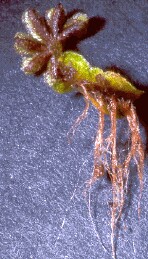
Gametophyte160Vert.jpg (27129 bytes)
Fern Gametophyte with hair-like Rhizoids
(lower right).

Root Hairs are an important Epidermal adaptation.
RootwithHairs.jpg (32383 bytes)

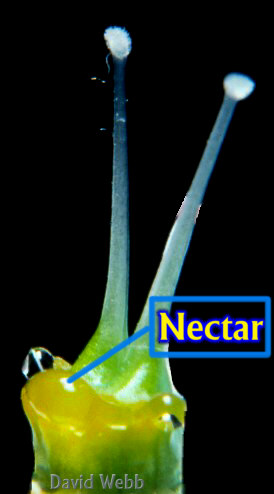
Hairs can Secrete substances to the surface.

SaxafragaGynoCloseLab.jpg (26088 bytes)
Gynoecium with other floral parts removed. Note the Nectar near the base of the Ovary.

Nectaries are the most important Epidermal secretory structures. These attract Pollinators and Defenders.

Flowering plants have developed highly BugPolnComposite.jpg (53665 bytes)specific interrelationships with pollinators which assure successful sexual reproduction. Pollinators  usually visit flowers to collect Nectar.

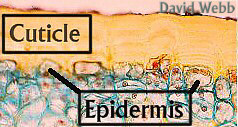
CuticleLab.jpg (22821 bytes)
Note the Thick Cuticle which prevents water loss.!
MarchantiaThalli400.jpg (31458 bytes)
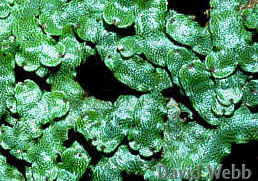
Marchantia thalli - Their shiny appearance is due to a waxy Cuticle.StomCPlastGC200.jpg (7778 bytes)
Stomata regulate the movement of water from the leaf & stem.
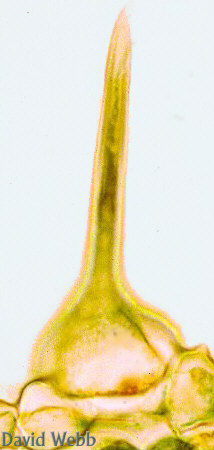
Image374.jpg (23844 bytes)
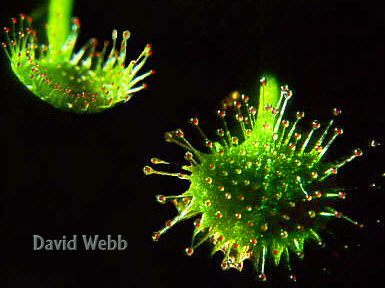
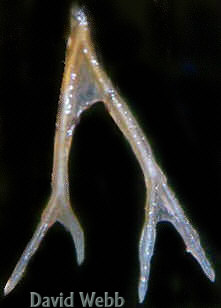
Some hairs deter herbivory!Drossera400.jpg (26679 bytes)
Some hairs capture prey!
The complex Glandular hairs of Drosera reach the apogee of trichome evolution.

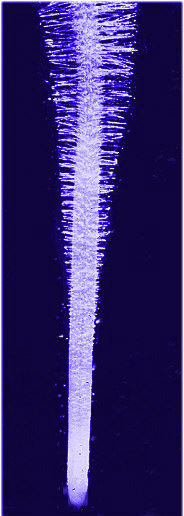
Roots240.jpg (17859 bytes)
Roots are specialized to absorb water from the soil.

TrichOhiaSEM.jpg (33541 bytes)
An SEM photo which shows that the Epidermis of ohi'a lehua is covered with Trichomes. These create a large "boundary layer" which moderates water loss via transpiration.

OhiaPubPolLab.jpg (61337 bytes)


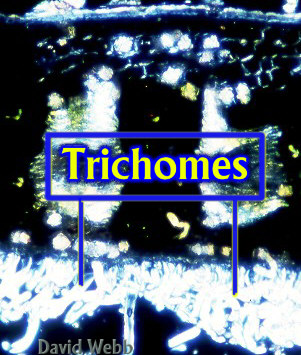
Cross-section of an Ohi'a lehua leaf viewed with polarized light. The Trichomes are birefringent and appear as bright structures. Note the abundance of Trichomes on the lower surface of the leaf. Stomata are also present on the lower leaf surface. The Trichomes moderate water loss when the stomata are open.

The Anthophyta are the only plant division that produces many kinds of Epidermal Hairs!
The Pterophyta produce a smaller variety of Scales and Hairs.

WB01342_1.gif (1360 bytes)

Lecture Directory