|
 |
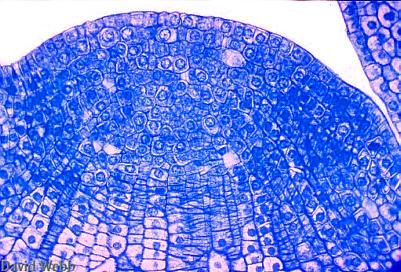
| Apical Cells
and their most recent derivatives constitute the Apical
Meristems of Ancestral Plants. This includes most species in the Hepatophyta, Bryophyta, Psilophyta, Sphenophyta, Lycophyta and Pterophyta.
Members of the Coniferophyta and Magnoliophyta have Multicellular Apical Meristems. |
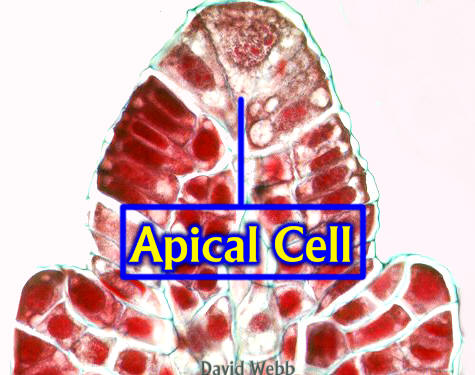 Equisetum Shoot apex with a prominent Apical Cell
|
Branching
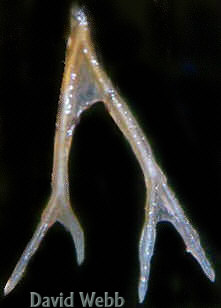
| Ancestral Plants had Isotomous
Branching in their Stems and Roots. This produces branches
of equal length at each branch point.This is a form of Dichotomous
Branching which occurs at the Shoot or
Root Apical Meristem. More Advanced plants had Anisotomous Branching. This produces a short branch and a long branch at each dichotomy. These alternate to give the illusion of a dominant main axis. The growth form produced is called Pseudomonopodial . True Monopodial Growth has its origin in Lateral Branching. Lateral Branches originate subapically and are associated with Leaves on stems. Lateral roots have an internal origin near the Stele. The main root is called the Primary Root while the Branches are called Secondary Roots. |
|