|
|
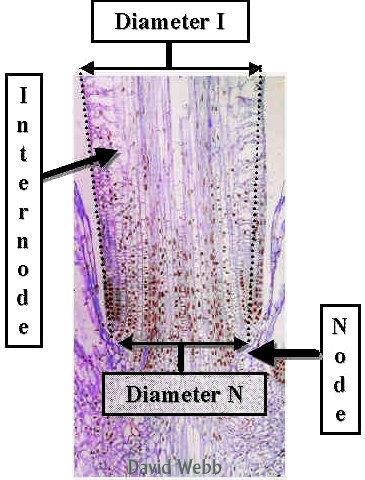
| Stem Anatomy The Apical Meristem is an Apical Cell. Apical Elongation by derivatives of the Shoot Apical meristem is Small and results in a minor amount of axial elongation. Cells at the upper Nodes remain Meristematic and continue to divide long after cell division at the apical end of the Internode have ceased. The mitotic cells at the Nodes are part of Intercalary Meristems (IM). The IM only produces cell towards the Apex. These elongate as they are displaced from the Node by more recent derivatives of the IM. The IM is responsible for the majority of stem elongation. The Model below tries to illustrate the differences between Apical & Intercalary Growth. Read the commentary in the right-hand column for an explanation.
I am not overly concerned that you understand this completely for this class. Few plants have Intercalary Growth in their stems. members of the Poaceae (grass family) have Intercalary Growth in their leaves. That's why you need to keep cutting grass to have a neat lawn. The growing point is at the base of the leaf rather than at the tip. Intercalary growth of the stem creates points of weakness at the upper nodes. These could be snapped by strong winds. Vascular development is also interrupted by the Intercalary Meristem & when vascular tissues do differentiate, the resulting vasculature is extremely complex & probably very inefficient. These are a few reasons why this kind of development is rare in extant plants. |
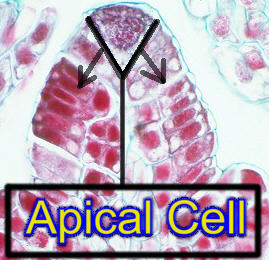 Shoot Apex of Equisetum
The Node produces cells towards the Apex with Equisetum. These cells elongate and enlarge radially. Consequently, cells at the node are smaller than those of the Internode. The Node has a smaller diameter than the Internode immediately above it. Select a Cell File at the Node & Follow it. Where is there evidence of mitosis? Where does cell elongation & expansion occur?
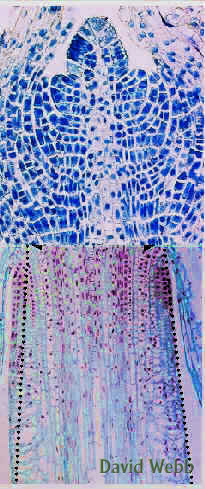
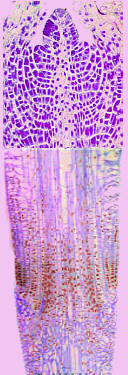
The Stem Diameter would gradually increase from the tip to the base until it reaches a Maximum that would extend down the stem from that point to the bottom. Compare this with the hybrid image I have created below which attempts to show the effects of Intercalary Growth.
|