|
|
| Equsietum
has Rhizomes & Aerial Stems,
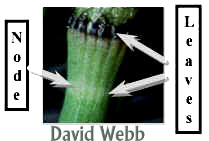
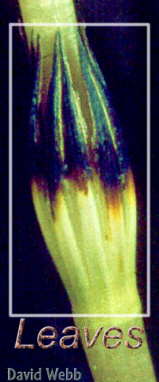
but also has Roots. The Aerial Stems & Rhizomes are decidedly Grooved & Stomata occur in the depressions. Does this remind you of anything we saw with Psilotum? What is the adaptive value of this trait? The stem is modular in that it breaks into uniform segments when tension is applied to it. Consequently, we can say that the stem is Jointed. The stem is hollow except at the Joints (Nodes) where a septum of tissue is present. Consequently, a stem that has two nodes will float. Is this a significant observation in terms of its ability to spread and reproduce asexually? The stem has definite Nodes & Internodes. A Node is a location on the Stem where a leaf is inserted. We did not use this term with Psilotum because there was some doubt regarding the status of its "Prophylls" as true Leaves. Each leaf of Psilotm defines a Node. The Internode is the length of stem between successive Nodes. The Leaves are called Microphylls. A Microphyll is a leaf with one vein that is connected to the Stele in the Stem. The Microphylls of Equisetem are Whorled. This means that there are three or more leaves at a single Node. The leaves are United and form a thin sheath that surrounds the stem & extends a cm. or two above each node. Each tip represents one leaf. The leaves are very thin and are not specialized for Photosynthesis. They may be green but most of the photosynthesis occurs in the stem. The leaves may represent a protective covering for the apex during early growth through the soil. They may also reinforce the node. Equisetum has Intercalary Growth. This means that meristematic cells are located at the Node. Such cells are structurally weak & could probably use some extra support, no-matter how small it might be. The leaves might also protect the lateral meristems present at each node (see below). |
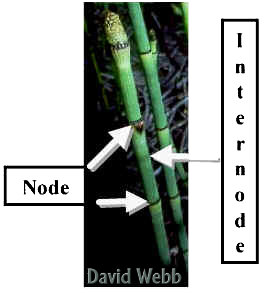 Equisetum stems showing Nodes and Internodes.
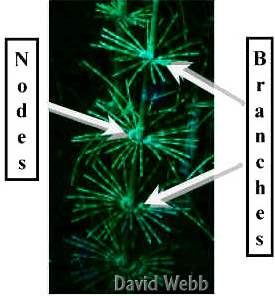
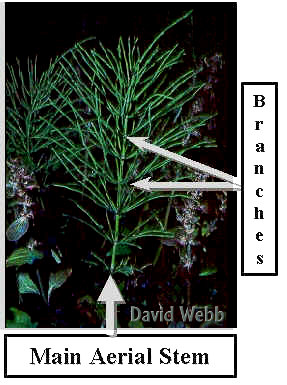
Equisetum with Expanded branches. |
The stem is called Monopodial because there is One Dominant Axis with Lateral Branching.
This distinguishes Equisetum from plants that have Anisotomous Dichotomous Branching which gives the appearance of one central axis. The latter is said to be Pseudomonopodial.
Branches occur at the Nodes. Preformed shoot and root primordia are present at each Node. Couple this observation with the jointed nature of the stem and what do you get????