 From Cell to Organ-7

There are two
Vascular Tissues, Xylem & Phloem.
The conducting cells in the Xylem are called Tracheary
Elements. These have thick walls that stain red
due to the presence of Lignin. Lignin makes their cell walls watertight,
inflexible and strong. Consequently, Tracheary
Elements have two main
functions, water transport and structural support.
They usually have a hollow appearance because they are dead at maturity.
These traits make Xylem relatively easy to spot in a cross section.
main
functions, water transport and structural support.
They usually have a hollow appearance because they are dead at maturity.
These traits make Xylem relatively easy to spot in a cross section.
Phloem
is associated with Xylem. Phloem cells do not generally have diagnostic
traits like xylem but they can usually be discerned by their position. They have
relatively thin cell walls and have a narrower diameter than the largest
Tracheary Elements. In some cases, Phloem exhibits a definite
pattern of small cells and large cells. The large cells are Sieve
Elements (S). 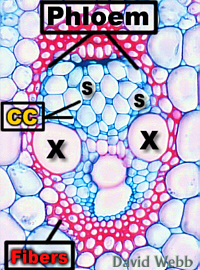 These are the cells that are specialized for Sucrose Transport.
The smaller cells are Companion Cells (CC). These
regulate the physiological activities of the Sieve Elements. Phloem contains
Callose. Callose regulates the size of the openings between adjacent Sieve
Elements. Callose is a carbohydrate that stains with Aniline Blue and is fluorescent under
Violet light. This is the best way to verify the presence of Phloem because Callose is not
present in other cell types.
These are the cells that are specialized for Sucrose Transport.
The smaller cells are Companion Cells (CC). These
regulate the physiological activities of the Sieve Elements. Phloem contains
Callose. Callose regulates the size of the openings between adjacent Sieve
Elements. Callose is a carbohydrate that stains with Aniline Blue and is fluorescent under
Violet light. This is the best way to verify the presence of Phloem because Callose is not
present in other cell types.
