 From Cell to Organ-6

The purpose
of this lecture is to acquaint you with the various types of tissues found in Vascular
Plants and to show you how they are organized to form a "Typical Vascular
Plant". This may seem daunting at first until you realize that basic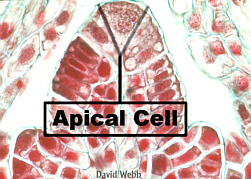 plant anatomy is
very simple.
plant anatomy is
very simple.
Cell Types & Tissues
Meristematic Tissue
Meristematic
tissue produce all the cells in herbaceous plants. The cells originate in the Root or
shoot Apical Meristems. Meristematic Cells are Spherical
(Isodiametric) and densely cytoplasmic. They have a relatively large Nucleus,
few Vacuoles and thin Cell Walls. Consequently, they
readily absorb biological stains and appear as dense areas in the apices
of Roots and Shoots. The Apical Meristem in Roots is actually subterminal because it is
covered by a Root Cap. The root cap protects the delicate meristem cells and it also
secretes carbohydrates which lubricate the root as it grows through the soil.
They have a relatively large Nucleus,
few Vacuoles and thin Cell Walls. Consequently, they
readily absorb biological stains and appear as dense areas in the apices
of Roots and Shoots. The Apical Meristem in Roots is actually subterminal because it is
covered by a Root Cap. The root cap protects the delicate meristem cells and it also
secretes carbohydrates which lubricate the root as it grows through the soil.
There are two
basic types of Apical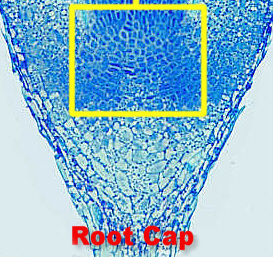 Meristems. Nonseed plants have a large Apical Cell which gives rise to
the plant body. Seed plants have Multicellular Apical Meristems which
function as a unit.
Meristems. Nonseed plants have a large Apical Cell which gives rise to
the plant body. Seed plants have Multicellular Apical Meristems which
function as a unit.
Primary Tissues
There are Three Basic Tissues that comprise all herbaceous (soft bodied) plants. These are Dermal, Vascular & Ground.
Plants are
made like reinforced concrete.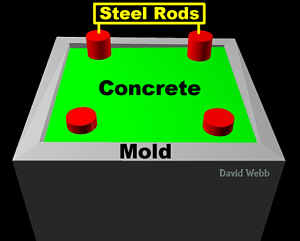 There is a outer mold,
steel rods and concrete which fills in the rest of the
volume.
There is a outer mold,
steel rods and concrete which fills in the rest of the
volume.
The first tissue is the Epidermis which is typically on the surface (Dermal) and is usually one cell thick. If it is on the surface it is probably Epidermis. This is like the mold for the concrete.
The
next is Vascular Tissue. It is typically found in longitudinal
columns. There may be one large central  column, a ring
of smaller columns or multiple rings of small columns. These columns are
the steel rods.
column, a ring
of smaller columns or multiple rings of small columns. These columns are
the steel rods.
Finally, there is the Ground Tissue which occupies the rest of the plant organ. This is like the concrete above. I regard the Ground Tissue as BACKGround Tissue.
Cross Section of a Coleus Stem: Note the large Vascular Bundles in each corner of the stem (steel rods). Everything else is Ground Tissue (Concrete) except for the Epidermis (Mold) which forms the surface layer of cells. |
 |
The Epidermis is readily identified by its location.
Vascular Tissues, especially Xylem, have strong characteristic traits which make them relatively easy to identify.
If it is neither Epidermis nor Vascular Tissue, it must be Ground Tissue.
