 From Cell to Organ-5

The next step lead to the
evolution of distinct Shoots and Roots.
The shoots were specialized for 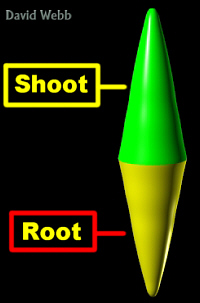 Photosynthesis
and the Roots were specialized for absorption and anchorage. Root anatomy would not differ
significantly from the cylindrical Rhizome we saw earlier. Furthermore, Root Anatomy is
very constant in Land Plants. Branching occurred in the roots and produced a complex root
system.
Photosynthesis
and the Roots were specialized for absorption and anchorage. Root anatomy would not differ
significantly from the cylindrical Rhizome we saw earlier. Furthermore, Root Anatomy is
very constant in Land Plants. Branching occurred in the roots and produced a complex root
system.
Upright stems were able to overtop flat thalli and became dominant organisms. The production of photosynthetic branches further increased the surface area available for photosynthesis.
The ascent of aerial stems and 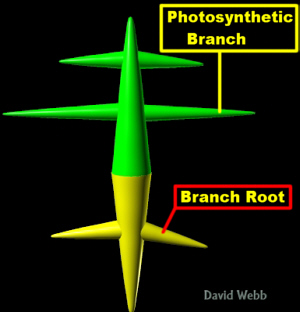 their
branches required the development of support tissues. Xylem Tracheary
Elements have thick walls and provide some structural support. However,
Sclerenchyma (Scler = Hard) tissue evolved and Sclerenchyma Fibers provided extra
mechanical strength. Fibers are found in the Vascular Tissues or in close association with
them. Sclerenchyma and Parenchyma
are the two principal Ground Tissues.
their
branches required the development of support tissues. Xylem Tracheary
Elements have thick walls and provide some structural support. However,
Sclerenchyma (Scler = Hard) tissue evolved and Sclerenchyma Fibers provided extra
mechanical strength. Fibers are found in the Vascular Tissues or in close association with
them. Sclerenchyma and Parenchyma
are the two principal Ground Tissues.
The final step in the evolution of our theoretical plant is the production of Leaves. These are highly specialized for Photosynthesis in many ways. They usually have a wide thin Blade (Lamina) and a thicker Midrib. They may have only one Vascular Bundle (Vein) or a network of interconnected Veins. They are attached to the stem by a nonphotosynthetic petiole.
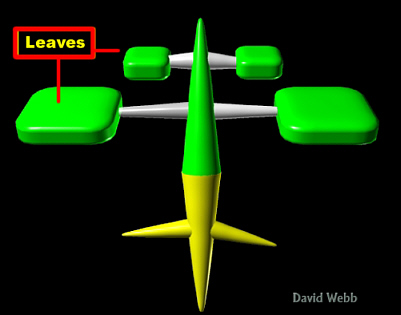
The major functions of the stem are translocation of water and photosynthate and structural support for the leaves.
Our theoretical plant has three distinct Organs (Leaf, Stem & Root).
