 From Cell to Organ-4

Thallus
Shape is important because plants need to minimize water evaporation. A sphere has
the least amount of Surface Area / Volume ratio. A flat sheet has the greatest Surface
Area / Volume ratio. Water would evaporate more readily from the sheet because more
molecules are in direct contact with the atmosphere.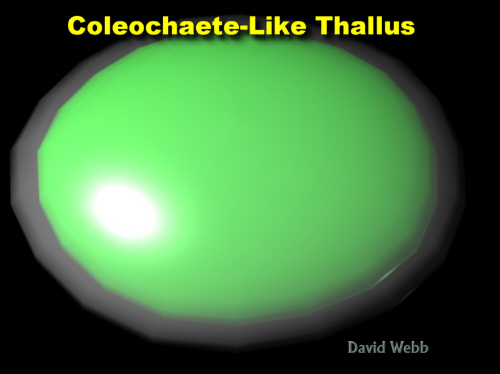 However, plants need to perform
Photosynthesis in order to survive. Consequently, plants need to maximize their surface
area to intercept as much light as possible. The process of evolution has selected plants
which are best able to balance these two conflicting needs.
However, plants need to perform
Photosynthesis in order to survive. Consequently, plants need to maximize their surface
area to intercept as much light as possible. The process of evolution has selected plants
which are best able to balance these two conflicting needs.
The first land plants probably
resembled a discus which was thin at their margins and thick in the middle. This is
similar to certain Green Algae (Coleochaete). However, this shape has a
relatively large Surface / Volume ratio. There are no large land plants with this kind of
shape. Consequently, other shapes must have had greater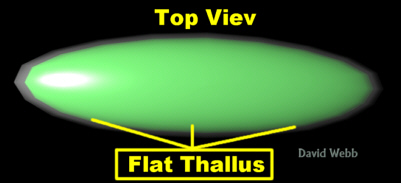 adaptive value.
A strap-like thallus would have
less surface area compared to a disk-like thallus and there are some land plants that have
this kind of shape. This kind of thallus would be multilayered in its center and
unilayered at its margin.
multilayered in its center and
unilayered at its margin.
A Cylinder has even less Surface
Area / Volume than a strap-like structure. The first fossil land plants had cylindrical
thalli and some extant plants 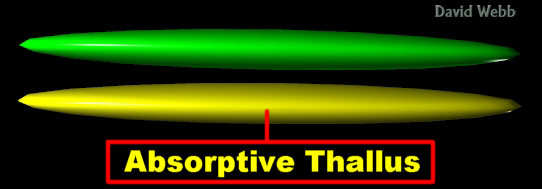 have retained this shape. These
thalli would be similar to stems and roots. The first cylindrical organisms probably had
horizontal photosynthetic stems called Stolons. Specialized,
absorptive
have retained this shape. These
thalli would be similar to stems and roots. The first cylindrical organisms probably had
horizontal photosynthetic stems called Stolons. Specialized,
absorptive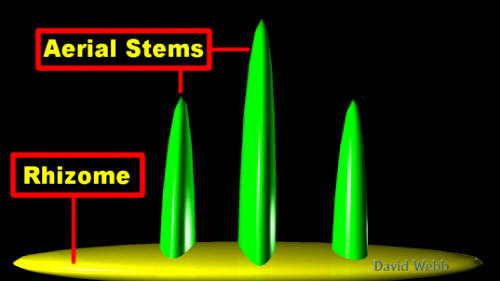 underground stems called Rhizomes developed and
produced upright, aerial, photosynthetic stems.
underground stems called Rhizomes developed and
produced upright, aerial, photosynthetic stems.
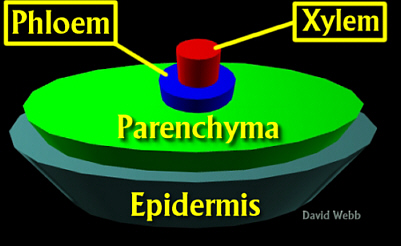
Initially, all of these Organs had one central strand of Vascular Tissues (Xylem & Phloem), a cylinder of Photosynthetic Parenchyma (Chlorenchyma) and an Epidermis.
 |
 |
| Cross-Section of a Flat Thallus showing the internal Tissues | Cross-Section of a Cylindrical stem showing the internal Tissues |
