 From Cell to Organ-3
In order for a
complex colony or organism to survive, water and sucrose must be distributed
throughout the organism. Cells are interconnected by small cytoplasmic channels in their
cell walls called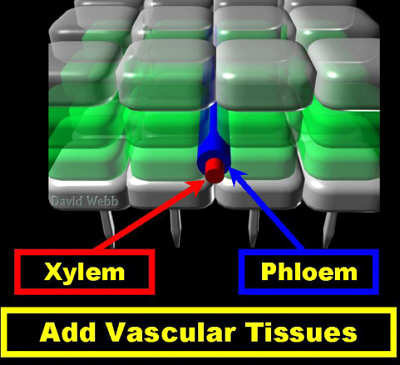 Plasmodesmata.
Furthermore, small molecules can move by diffusion through the water in the cell walls.
However, both of these process are extremely slow and could not be sufficient for large
organisms to survive. Vascular tissues are specialized for
the transport of water and sucrose dissolved in water. The most simple Vascular plants
have one vascular bundle composed of Xylem and Phloem.
Plasmodesmata.
Furthermore, small molecules can move by diffusion through the water in the cell walls.
However, both of these process are extremely slow and could not be sufficient for large
organisms to survive. Vascular tissues are specialized for
the transport of water and sucrose dissolved in water. The most simple Vascular plants
have one vascular bundle composed of Xylem and Phloem.
Xylem is specialized for water transport.
Phloem is specialized for sucrose transport
The next step could
have been the 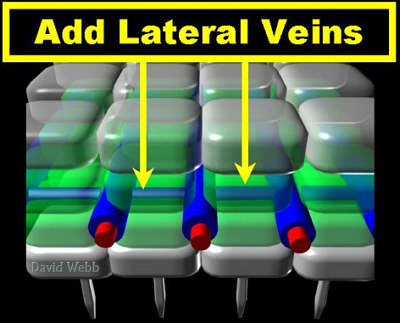 multiplication of Vascular Bundles and
their interconnection via Lateral Bundles.
multiplication of Vascular Bundles and
their interconnection via Lateral Bundles.
This level of complexity is the equivalent of a Leaf! The leaf is an Organ. Consequently, our theoretical plant has reached the Organ level of complexity.
All Plant Organs are composed of Three Tissues (Epidermis, Parenchyma & Vascular)!
The next steps in evolution involved the formation of separate organs which are specialized for water acquisition & anchorage [Root], photosynthesis [Leaf] and vertical growth [Stem].
