


Forests in Flux



Predicting
the Responses of Forest Ecosystems to Climate Change
 There
is growing consensus that climate change will have a profound affect
on forest ecosystems over the next century. The impacts of climate change
on forest ecosystems are of fundamental concern to governments, scientists
and general public alike and the threat of their destruction has been
one of the key motivating forces behind the Framework Convention on
Climate Change and subsequent Conferences of the Parties.
There
is growing consensus that climate change will have a profound affect
on forest ecosystems over the next century. The impacts of climate change
on forest ecosystems are of fundamental concern to governments, scientists
and general public alike and the threat of their destruction has been
one of the key motivating forces behind the Framework Convention on
Climate Change and subsequent Conferences of the Parties.
Conservation planning must take into account the major threats to forests if resources and effort devoted to forest conservation are not to be wasted. The need is here to determine which forest areas are most at risk so that a representative fraction of all the important ecosystems around the world can continue to be protected, under predicted future climatic regimes. In order to do this, a methodology to assess the impacts of climate change on forest biodiversity is required, as well a strategy for addressing the problem.
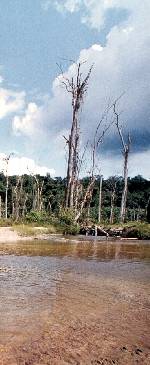
The goal of the Forests in Flux project is to define priority areas for the establishment of a global network of protected areas in forest ecosystems. One of the key activities identified to help achieve this goal has been to: review and assess predicted responses of forest ecosystems to climate change, focusing specifically on key issues for conservation, particularly ecosystem tolerance and loss of biodiversity.
This activity was identified as of fundamental importance to the further development of the project, because without a full understanding of the responses of the various forest ecosystems of the world to climate change, neither the scope nor the outputs of the project could be properly defined.
One of the methods adopted to help assess the current information and knowledge base of predicted responses of forest ecosystems to climate change has been to establish an ecosystem response (forests and climate change) database. Broadly speaking, this contains summaries of model specifications, parameters, nature of predictions, references and a listing of all relevant collaborators and their main interests in the subject. This database has been made available here in a searchable form. This was part of Phase I of the Forests in Flux project (funded by UNEP) that was carried out at the end of 1999 by WCMC, in collaboration with the University of Edinburgh and Edinburgh Centre for Carbon Management Ltd.
Ecosystems identified as being under greatest threat have been highlighted for a more detailed analysis in Phase II.
For help with this web site contact:
|
Forest Programme |
Information Enquiries |

 Search