|
||
|
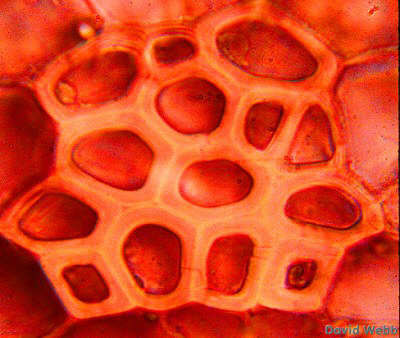
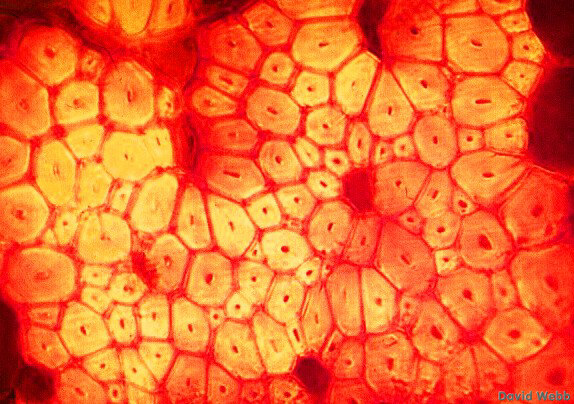
Fibers are the second type of sclerenchyma. They are usually present in bundles. Their walls are very thick and exceedingly well organized with many laminations. They are usually lignified. The cells are highly elongate and have overlapping endwalls. All of these traits give them considerable strength. They provide support after elongation has ceased. | |
|
The hau plant has bundles of fibers in its stem. These were used by ancient Hawaiians to make twine. | |
 |
Scanning Electron Microscope Image of Fibers: Note that they occur in a group (bundle). Cell Wall accounts for most of the total volume of these cells compared to the surrounding Parenchyma cells. The fibers were artifically colored to show that they contain Lignin. | |
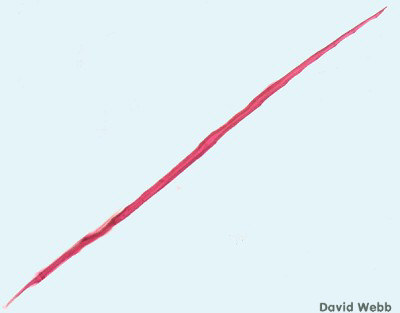 |
Fibers commonly occur in wood. This is from Oak. We will explore these later in the semester. | |
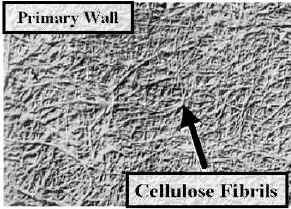 |
Cellulose Microfibril orientation is usually random in cells which are still enlarging. This is easy to imagine if you think of a baloon with lines painted on it. Their orientation will change as the baloon fills with air. | |
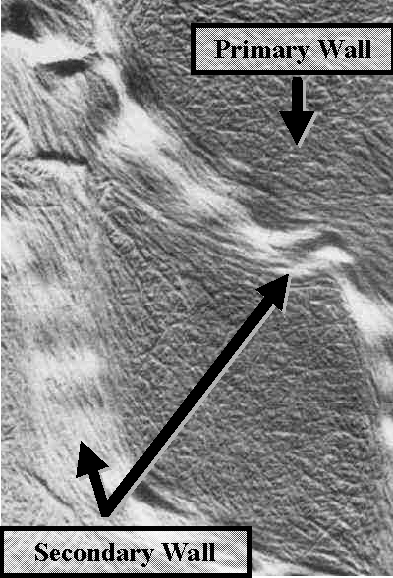 |
The secondary wall is produced AFTER enlargement has ceased. These are highly organized, especially in Sclerenchyma. The pitch of the secondary walls depends on the orientation of Microtubules. Alternating layers have an opposing pitch. This produces a laminated wall that is extremely strong. | |
 Prior Page |
Home Page |  Next Page |