|
|||
 |
Cuticle of Clivia - The cuticle forms an impervious boundary between the cells in the leaf and the environment. The cuticle keeps water in & pathogens out. Plants that grow in extremely dry environments usually have thick cuticle layers & Lignification of the cell walls may also occur. | ||
 |
This plant has an excellent cuticle!!! The cuticle stains orange in this specimen. | ||
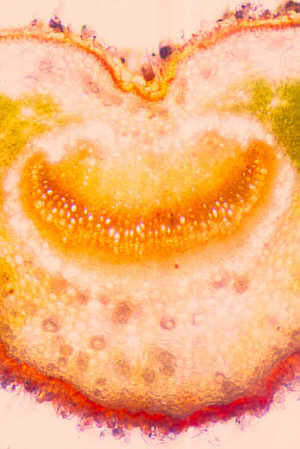 |
Midrib of Ohi'a lehua showing extensive cuticle development on the Upper and Lower Epidermal Layers - Stained with Sudan IV (Red). The lower Cuticle has absorbed more stain. | ||
 |
Lamina (blade) of Ohi'a lehua stained with Sudan IV. Cuticle is also prominent on both surfaces. | ||
 |
More Ohi'a lehua cuticle (C). Also note the abundant Trichomes (T) on the lower abaxial surface. | ||
 |
These trichomes (seen with SEM) can occur on both the upper (Adaxial) or lower (Abaxial) surfaces. What might be their ecophysiological role? | ||
 |
The trichomes are birefringent. what does this tell you about the cell walls of these cells? | ||
 |
Ohi'a lehua leaf lower surface. This is densely covered by Trichomes. | ||
 |
Ohi'a lehua leaf lower surface partly scraped. | ||
 |
Ohi'a lehua leaf lower surface
completely scraped. These trichomes have ecophysiological significance! |
||
| Lecture Directory |  Prior Page |
 Home Page |
 Next Page |
|---|---|---|---|

