Secondary Xylem-Wood-7

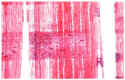
28podxp.jpg (58766 bytes)
Prior Page

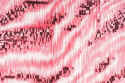
50drmrad.jpg (40009 bytes)
Lecture Directory

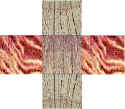
WoodModl.JPG (300079 bytes)
Next Page

Angiosperm Wood

Angiosperm wood is generally more complex than Gymnosperm. Oak (Quercus) has the widest array of different cell types and will serve as an extreme example.

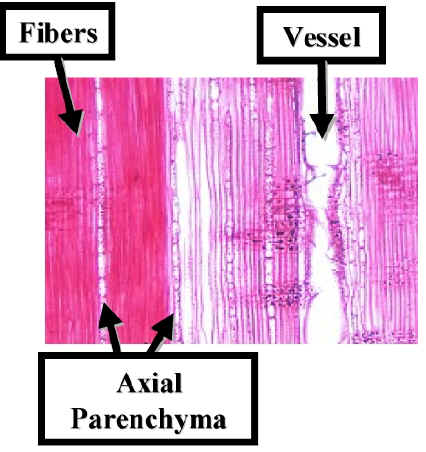
The axial system angiosperms have both kinds of Tracheary elements (Vessel Members & Tracheids). Furthermore, Fibers may also be present, as well as Axial Parenchyma.   Some of these can be distinguished in Transverse (Cross) sections but others may not become clear unless long sections are studied.

ringpor1.jpg (76993 bytes)


Transverse section of Oak showing enormous Vessel Members in the Early Wood and smaller ones in late Wood. Other cells type include Fibers and Parenchyma.

Transverse section of Oak 33oakxs.jpg (31306 bytes)showing cells in the Late Wood. The circular cells are Axial Parenchyma, the other cells are Fibers.Note the presence of Small Rays.

34oaktan.jpg (94513 bytes)
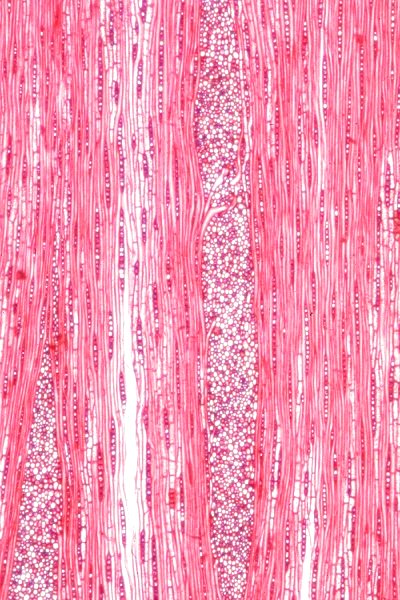
Tangential Section through Oak Wood. The largest structures observed in this section are massive Multiseriate Rays!!!!! Note the presence of smaller rays, as well. A small Vessel can be seen left of center. Elongated, thick walled Fibers are also apparent.

35oakrad.jpg (33277 bytes)


Oak Radial Sections. I can see the side of the Fence (Ray).OakRadSec240Lab.jpg (27726 bytes)


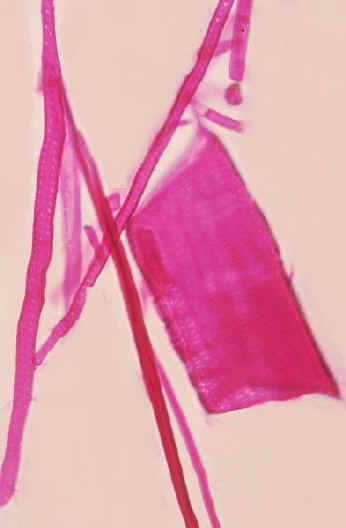
Mascerated Oak Wood

Cell types are best distinguished in mascerated wood.

VesselMemberOak.jpg (5476 bytes)


Vessel Member - Note the complex patterns of Pits on the Side Walls.

45vesmem.jpg (25470 bytes)


Vessel Member with Tracheids and a Fiber

61veselm.jpg (28832 bytes)


Elongated Vessel Member

trachmas.jpg (10860 bytes)


Tracheid - Note the many Pits and the absence of a Perforation Plate

OakTrachAxParen240Lab.jpg (75074 bytes)

Axial Parenchyma

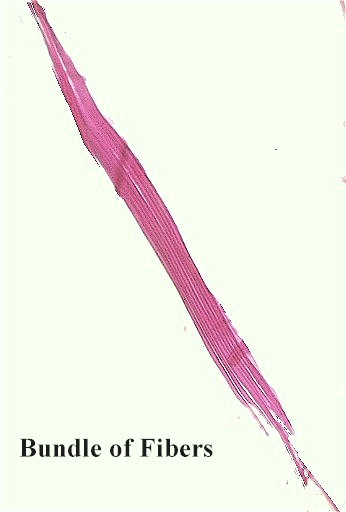
OakFiBund1Lab.jpg (48068 bytes)
A Bundle of Fibers - Note the absence of Pits

OakLibFib.jpg (11459 bytes)


Individual Fibers.