Back to the Question |
|
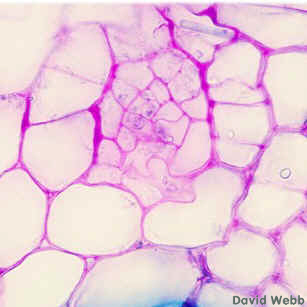
These are seen at a reduced Magnification. They are larger than the "embryonic" vascular bundle seen in the opposite table cell. |
 Prof.
Bullwinkle says that Cell Divisions in
the STM lead to the immediate differentiation of Vascular Bundles.
I have called these "embryonic" but the word incipient could also be used.
Consequently, secondary vascular growth in monocots results
in the production of Vascular Bundles. Each is composed of Xylem, Phloem and some strengthening elements
associated with the xylem. This accounts for the complex
anatomy of the central stem. Prof.
Bullwinkle says that Cell Divisions in
the STM lead to the immediate differentiation of Vascular Bundles.
I have called these "embryonic" but the word incipient could also be used.
Consequently, secondary vascular growth in monocots results
in the production of Vascular Bundles. Each is composed of Xylem, Phloem and some strengthening elements
associated with the xylem. This accounts for the complex
anatomy of the central stem. The next time you look at a tall palm tree, meditate on this and try to imagine the complex organization of vascular bundles in the stem. Most arborescent monocots grow rather slowly. This could be due to the extreme complexity & inefficency of this vascular system. The latter may be a limiting factor for maximal stem elongation. Furthermore, the Vascular Bundles must supply structural support for the stem. The isolated bundles in Palms and ti are probably weaker than the continuous rings of secondary xylem is Oak or Sequoia. However, If you watch palm trees in a gale, they bend but do not break. The looser organization of vascular bundles in such stems might make them more flexible. Vines also have highly dissected secondary vascular tisssues. This may consequently allow them to withstand wind velocities that would snap Pines of equivalent size. There are clearly other facotors involved but this is a reasonable hypothesis. Now, if only I could figure out why palm trees don't grow in Frostbite Falls I would truly become worthy of my DDT! |
|
It must be nice to be so smart AND good looking!!!!!!