|
|||
 Cross-Section of a Dicot Stem Cells in the Xylem have stained red for lignin. Xylem and Phloem are the Vascular Tissues in MOST plants. They are usually found together. Most people are familiar with vascular tissues in stems. Thus we will start with stem cross-sections. The vascular tissues in stems are found within bundles which are continuous over a relatively large distance. Cells in the xylem have thick lignified walls which stain red for lignin in most preparations. The Conducting cells in the Xylem are called Tracheary Elements |
|||
Both Xylem and Phloem have cytological traits which distinguish them from the surrounding tissues. The Lignified walls of the Tracheary Elements in the Xylem are the most distinctive of these.
Xylem & Phloem are said to be "complex tissues" because they contain Fibers and Parenchyma as well as Tracheary Elements (Xylem) & Sieve Elements (Phloem). |
|||
The most specialized cells of the Xylem are called Tracheary Elements. These serve two functions, physical support & water conduction. Vessel Members (VM) have large openings in their end walls. These are the "Perforation Plates". |
|||
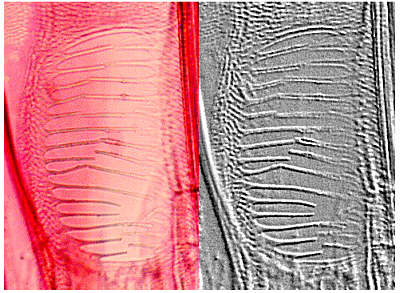
Note the ladder-like
segments of cell wall which form the Perforation Plate on the
end-wall of this Vessel These restrict the flow of water but may add some strength at the point where the Vessel members connect. I used an embossing tool to generate the image on the right. |
|||
The most advanced VM have no wall obstructions between succeeding members of a Vessel. These have "Simple Perforation Plates". Both of the cells below have simple Perforation Plates. Elongated cells with a narrow diameter are better for support. Shorter wider cells are better for conduction. |
|||
|
 Wide Vessel member with a simple Perforation Plate. This kind of cell is better for conduction than physical support. Note the numerous PITS on the lateral walls. |
||
Tracheary Elements also contain many pits on their side walls. This provides for Lateral transport. |
|||
Tracheids are the other type of Tracheary Element. Their end walls contain numerous pits, however, which
facilitate the longitudinal transport of water. Vessel Members |
|||
Comparison of
Tracheids and Vessel Members |
|||
 |
Home Page |  |
|
|---|---|---|---|