|
 Lecture Directory |
 Next Page |
|
Lecture Directory |
Next Page |
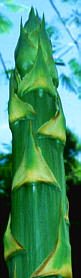
Monocots like Sugarcane and Corn have numerous Vascular Bundles in their leaves and consequently in their stems. The distribution of the Vascular Bundles in monocot stems looks disorganized at first glance. However, they are very well organized, but their organization is complex compared to Dicots.

While Asparagus is not the plant usually presented in textbooks, it shows traits which are similar to those in Corn & Sugarcane.
|
|
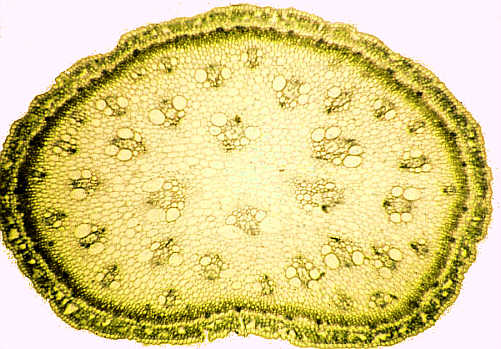
| Cross-Section of Asparagus Stem - Note the number and size diversity of the Vascular Bundles. | 3D Model of a Monocot Stem. The Blue Shafts represent Vascular Bundles. |
The stem is covered by an Epidermis which has a thick Cuticle & Stomata.
The outer part of the stem is photosynthetic and contains Chlorenchyma and small Vascular Bundles.
This is followed by a zone of thick-walled Sclerenchyma cells.
The rest of the stem is composed of Parenchyma in which Vascular Bundles are embedded.
There is no Pith as vascular bundles can be found near the center of the stem.
There is a progression in the size of the Vascular Bundles from small to large as one proceeds from the outside to the center of the stem.
|
|
|
|
| Large Vascular Bundles in Asparagus: The Vascular Bundles in Asparagus are a little unusual in that the Xylem almost surrounds the Phloem completely. | |
The vascular bundles (VBs) in corn (Zea mays) are "classical" Monocot VBs. They are surrounded by a Bundle Sheath which can be sclerotic. The Phloem has a highly organized appearance. The cells with the greatest diameter are the Sieve Tube Members. The smaller cells are Companion Cells.
The Xylem consists of large Metaxylem Vessel Members and smaller Protoxylem. Corn stems elongate rapidly and many of the protoxylem tracheary elements are destroyed in this process. Consequently, the TEs may be missing and a protoxylem cavity (lacuna) can be seen instead.
|
|
| Vascular Bundles from Corn Stem - The Classic Monocot | |
|
Sugarcane Vascular Bundle Stained with Toluidine Blue Compare with the VB from Corn & Identify the same structures that are labeled above. |
|
Lecture Directory |
 Top |
Next Page |


