Rhodophyta - Reefs -
2
Rhodophyta - Reefs -
2 

Red Algae
have Phycobilisomes & Phycobillin Pigments that are similar to
those in the Cyanophyta. These include the following:
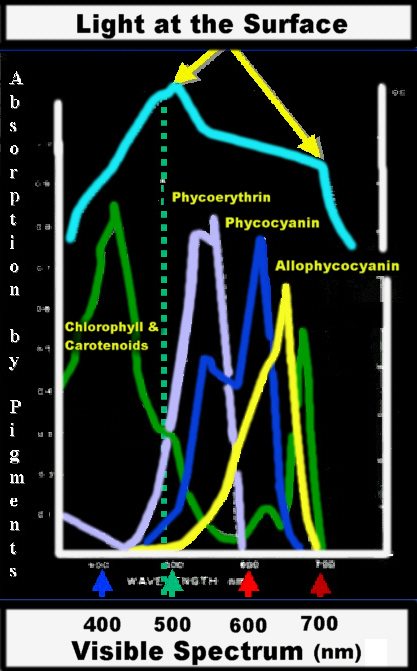
C-Phycocyanins Absorbs Green-Yellow Light (615-620)
Allophycocyanins Absorb Orange-Red (650-670)
C-Phycoerythrin Absorbs Green Light (495-570)

The Visible Spectrum
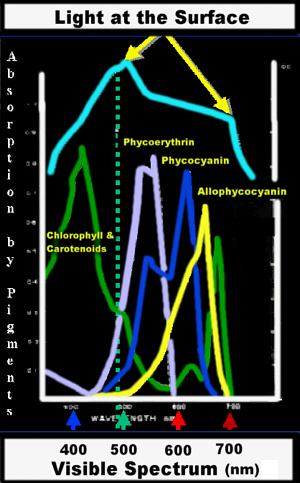
The amount of
visible light peaks
around 500 nm & Drops Off at Higher & Lower Wavelengths.
This encompasses PAR (Photosynthetically
Active Radiation). This means that light energy in this
region can be used in Photosynthesis if it is absorbed by Chlorophyll or Accessory
Pigments.
Chlorophyll
& Carotenoids have
Broad Absorbency in Blue light.
Absorption decreases in Green light and picks up in Red Light.
They absorb poorly at 550-650 nm
Phycobillin
Pigments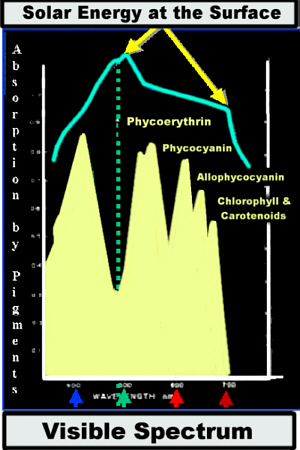
Phycoerythrin
Good
Absorbency 500 - 600 nm
Phycocyanin
Good Absorbency 550 - 650 nm
Allophycocyanin
Good Absorbency 600 - 675
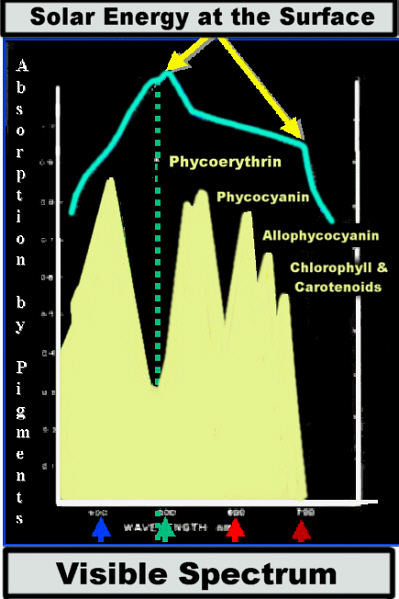
When all of these pigments are Combined most regions of the Visible Spectrum
are strongly absorbed.
The
exception is around 500 nm (Green Line) but there is some absorbency at this wavelength.
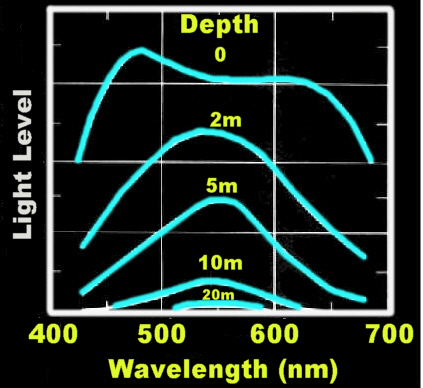
Absorption of Light by Water (Baltic
Sea)
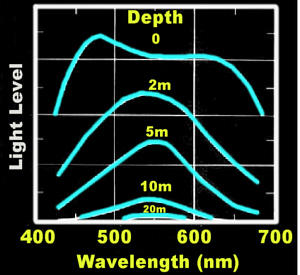
Red
& Blue wavelengths are preferentially Absorbed
Wavelengths from 500 - 600nm are Absorbed Least
This
corresponds with
Absorption Spectra of
Phycobillins
Consequently, algae with
Phycobillins can absorb photosynthetically active light at lower depths than other
organisms.