 Growth Forms in the Florideophyciae-2

Growth Forms in the Florideophyciae-2

 Equisetum Stem |
Some Rhodophyta Thalli are Cylindrical.
This is achieved by having closely spaced lateral branches that are arranged in whorls along the central filament(s).
One way to understand this is to examine Equisetum stems.
Equisetum has an unbranched central axis (stem).
Branches are produced at its Nodes (where leaves are attached).
The branches are distributed around the axis in whorls.
If we add more branches between the nodes 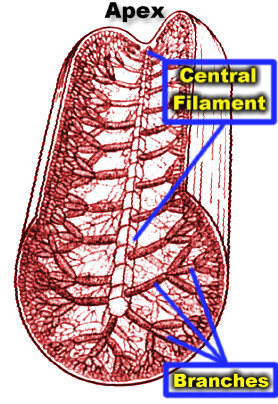 so
that the stem is completely covered by branches and dipped the stem in Gelatin we would
have something that resembles a cylindrical Rhodophyta thallus.
so
that the stem is completely covered by branches and dipped the stem in Gelatin we would
have something that resembles a cylindrical Rhodophyta thallus.
The image to the right is a three dimensional model of a cylindrical Rhodophyta thallus.
It has an Apical Cell which produces a Central Filament.
The Central Filament produces branches that surround it.
A cell which produces a branch is called an "Initial"
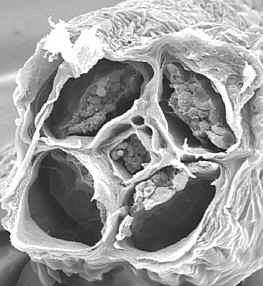
 Nemalion Thallus Cross Section |
These branches produce whorls of branches.
Each successive branch produces smaller cells so that the cells at the surface of the thallus are minute.
These can be called Epithallial Cells. These produce a false "Epidermis".
The more peripheral branches may fuse.
This produces a peripheral Cortex and a central Medulla.
 Multiaxial Thallus |
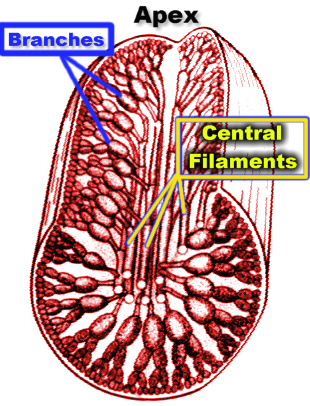
In the example above there was only one central filament.
Multiaxial Thalli which have several central filaments also occur.
Each Axial Filament has its own Apical Cell.
This is Illustrated on the right.
Polysiphonia is frequently used to study the Rhodophyta.
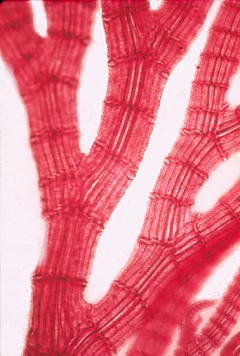
Its internal organization is illustrated below.
It has a solitary Apical Cell.
Its most immediate derivative divide
 |
longitudinally to produce a Central Filament surrounded by Four Pericentral Cells.
These produce Branches that fail to branch.
Only the "Initial" cell is produced at each successive branch point.
This produces a Cylindrical Thallus in which there is a progressive decrease in cell size in the Cortex.
 |
 |
 |
|
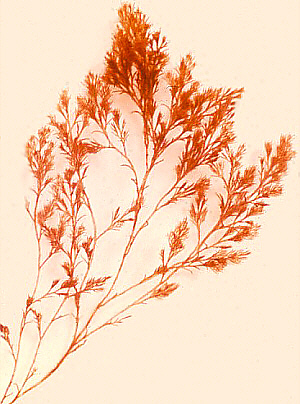
Polysiphonia Thallus Tips |
Polysiphonia sp. |
Polysiphonia Lower Thallus |
|
 |
 |
||
| Bostrychia moritziana Thallus Tips | Bostrychia moritziana Thallus X-Sec | ||
