WB01343_.gif (599 bytes)  Plant Cell Walls - 11 WB01345_.gif (616 bytes)
311 Syllabus


Pectins are hydrophilic and form Gel-like Matrix.

They are stabilized by Hydrogen Bonds as well.

They Fill in the Gaps between Cellulose and Hemicelluloses.

They prevent Collapse of Cellulose Fibrils.

They determine the Matrix Porosity (Size of Macromolecules that can diffuse through the matrix)

They are hydrated = 75% H2O

The removal of H2O -> decreases their flexibility.

Model showing the Long Cellulose Microfibrils with attached, interconnecting Hemicelluloses. These are held together by weak Hydrogen Bonds. However, there are so many of these bonds that the overall structure is very stable.
CellWallHemiLab.jpg (68105 bytes)
CellWallHemiPectinBlueLab.jpg (14746 bytes)
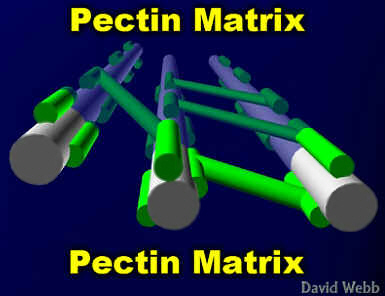
This model shows the Pectin Matrix that surrounds the other structural elements in the Cell Wall. Pectins are hydrophilic and are 75% water. Consequently, wter soluble molecules can move by diffusion through the Pectin Matrix.
CellWallLigninLab400.jpg (57793 bytes)
Pectins can be replaced by Lignin which is impervious to water. Lignin add a tremendous amount of strength to Cell Walls and also makes them inflexible.

Structural proteins (Stabilize & Loosen Wall Structure)

Extensin stabilizes cell wall structure and is more abundant in secondary walls.

Elastin participates in Wall Loosening.

Composition of Major Components Varies

Typical (Cellulose = 25%, Hemicellulose = 25, Pectins = 35%, Protein = 5%)

Secondary Walls have Higher Cellulose Levels

WB01342_1.gif (412 bytes)