Phaeophyta - Brown Algae-7

Holdfast
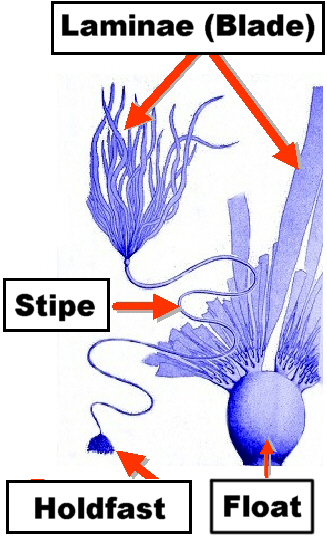
The Holdfast is particularly well developed in the Phaeophyta.
You may recall that the first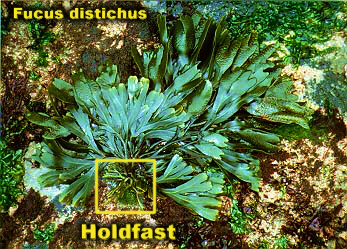 step
in the development of Fucus Zygotes is the production of the Rhizoid and Thallus
cells. The Holdfast develops from derivatives of the Rhizoid Cell.
step
in the development of Fucus Zygotes is the production of the Rhizoid and Thallus
cells. The Holdfast develops from derivatives of the Rhizoid Cell.
The Holdfast has obvious advantages for species that grow in wave swept environments. They would be dislodged otherwise.
Postelsia (Sea Palm) is an excellent example of this. It lives in areas that are exposed to pounding waves on rocky outcrops. It is hard to visualize the stress that this organism can absorb.

 Postelsia at Low Tide
|
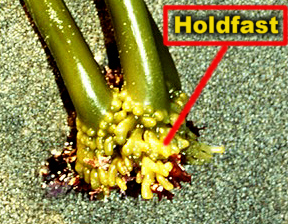 Postelsia Holdfast |
 |
|
 Nereocystis Holdfast |
|
 These Holdfasts resemble suction cups. |

Giant kelps like Macrocystis,
Nereocystis  and
Laminaria also have well developed Holdfasts. Areas that favor the growth of Kelps
show a definite stratification of species. This is partly based on the abilities of
different species to produce long Stipes. Without Holdfasts this stratification could not
occur because species would not be able to segregate themselves into zones of different
size classes. This would especially be true in areas that have heavy surf or strong
currents.
and
Laminaria also have well developed Holdfasts. Areas that favor the growth of Kelps
show a definite stratification of species. This is partly based on the abilities of
different species to produce long Stipes. Without Holdfasts this stratification could not
occur because species would not be able to segregate themselves into zones of different
size classes. This would especially be true in areas that have heavy surf or strong
currents.