Cyanobacteria
Link to Dr. Smith's Web Page on Cyanophyta
 Cyanobacteria
 Link to
"Seaweeds of Hawaii" by William H. Magruder and Jeffrey W. Hunt
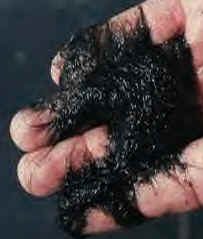 Oscillatoria au natural |
 Unknown Cyanobacterium from a warm spring near Mt. Lassen (CA) |


Planktonic (few species) Important source for fixed Nitrogen
Fringing
Reef Platform
Rubble Intertidal Zone in "Ooid Sand Grains"
Terrestrial
Surface Crusts which appear lifeless, are revived following significant rains. These dry
to a brittle crust as the substrate looses water. These can be
This can also be seen locally on abandoned, dry lots. Heavy
rains allow desiccated Cyanobacteria to flourish. They form undulating to round hydrated
masses. These gradually shrink and crack as the substrate dries. They sometimes appear
spherical.
dry lots. Heavy
rains allow desiccated Cyanobacteria to flourish. They form undulating to round hydrated
masses. These gradually shrink and crack as the substrate dries. They sometimes appear
spherical.
Some Cyanobacteria (CBs) are also found in "green snow" which appears in the springtime on semi-permanent snowfields and glaciers.
Endolithic (Inside Rocks)
Cyanobacteria have recently found in the most barren area of Antarctica where no other life has been found. Similar observations have been made in the high Arctic. They live just below the surface of rocks. This sounds unbelievable but it is true.
Cyanobacteria can also inhabit carbonatic substrates like Limestone. (http://bio.bu.edu/~golubic/marine-cyano.html).
Some species inhabit the Calcium Carbonate secreted by Coralline Algae.
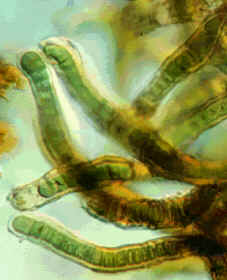
Hyella stella: a Cyanobacterium that lives in Marine Limestone
Scytonema endolithicum
Organisms like this can live in Coral Rubble which rolls about as "sand". Consequently, they inhabit a reef zone that would otherwise be unavailable to them, due to the absence of a stable substrate and the presence of vigorous wave action which would be unfavorable for Planktonic algae. These areas are often turbid due to wave & wind action and from soil runoff.
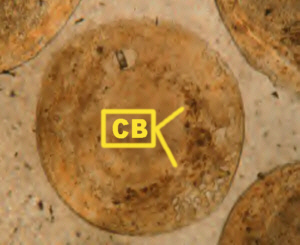
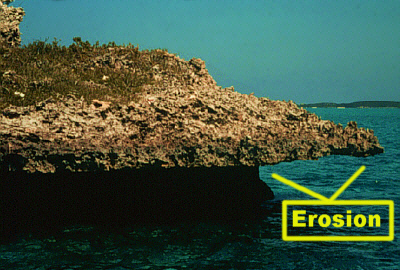
"Ooid" sand grain containing Endolithic Cyanobacterium (CB). The presence of these organisms in limestone & coral reefs can lead to erosion. This is caused by grazing animals who eat the Cyanobacteria and consequently decrease the amount of limestone present. The effect of this is illustrated below.
Erosion caused by Endolithic Cyanobacteria
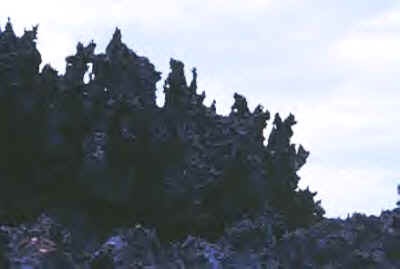
This can sometimes produce fantastic "Biocarst" shapes.
 |
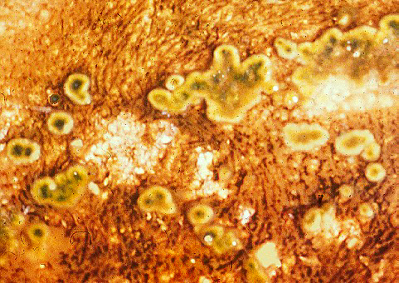 |
| Hot Spring at Yellowstone Park: The dark color is due to the presence of Cyanobacteria. | Limestone deposit at Yellowstone Park. The localized areas of green are due to the presence of Cyanobacteria |
Stromatolites (Stromatoliths)  are
large columnar Calcium Carbonate structures produced by
are
large columnar Calcium Carbonate structures produced by
CBs are thought to be the oldest Oxygen producing organisms. They profoundly changed the earth's atmosphere and allowed for the evolution of organisms that can use oxygen for respiration.

Fossil Cyanobacteria
 Illustration showing Fossil Stromatolites |
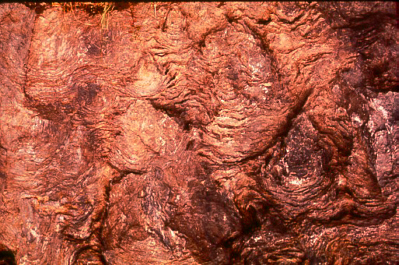 Limestone deposit from ancient Cyanobacteria (Glacier Park, Montana) |
 Living Stromatolites on the Beach |
 Stromatolites under water. |

Some are Symbiotic
Cyanobacteria are involved
in several symbiotic associations. CBs can fix atmospheric N which becomes
available for its symbiotic partner.
associations. CBs can fix atmospheric N which becomes
available for its symbiotic partner.
Lichens: Cyanobacteria are frequently the Photosynthetic partners of Fungi that compose Lichens. Lichens are important pioneer organisms which inhabit extremely difficult sites that may be dry, hot, cold,windy or all of the above.
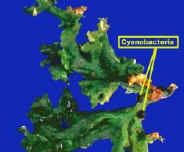 (inside-plant) Cyanobacteria which reside in mucilage filled chambers
within the thallus. Hornworts are colonizers and inhabit wet, unstable sites. The ability to get N from the CBs is
extremely advantageous because N is usually a limiting element in terrestrial
environments. As they decay Hornworts release their N which becomes available for more complex plants. Species in the
Anthocerophyta can be seen near eroded and trampled areas in the local mountains.
(inside-plant) Cyanobacteria which reside in mucilage filled chambers
within the thallus. Hornworts are colonizers and inhabit wet, unstable sites. The ability to get N from the CBs is
extremely advantageous because N is usually a limiting element in terrestrial
environments. As they decay Hornworts release their N which becomes available for more complex plants. Species in the
Anthocerophyta can be seen near eroded and trampled areas in the local mountains.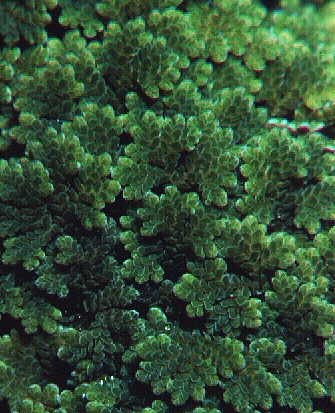 symbiosis with Nostoc species. These inhabit a cup-shaped area
formed by the ventral leaves of the fern. The CBs fix nitrogen and release nitrogen-rich
metabolites into the leaf cavity. These are absorbed by the
Azolla which releases
carbohydrates that are absorbed by the CBs. It is almost
symbiosis with Nostoc species. These inhabit a cup-shaped area
formed by the ventral leaves of the fern. The CBs fix nitrogen and release nitrogen-rich
metabolites into the leaf cavity. These are absorbed by the
Azolla which releases
carbohydrates that are absorbed by the CBs. It is almost impossible to separate the symbiotic
partners once they become established. This relationship has
been used for centuries in rice cultivation because it provides a cheap, renewable and
pollution-free source of fertilizer.
impossible to separate the symbiotic
partners once they become established. This relationship has
been used for centuries in rice cultivation because it provides a cheap, renewable and
pollution-free source of fertilizer. Cycas |
 Upward Growing Root Nodules |
 Cross Section through a root nodule showing the dark zone that contains Cyanobacteria. |
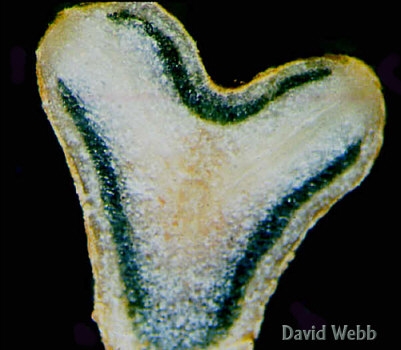 Long Section through a Root Nodule: The dark areas contain Cyanobacteria. |
 Commercial Cross Section showing the "Algal Zone" which contains CBs |
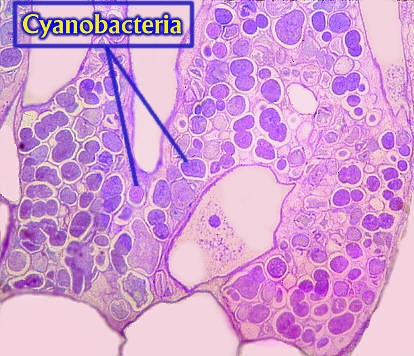 Thin section showing the Cyanobacteria in the "Algal Zone". |
 |
 |
| Gunnera growing in Hawaii | |
 Synechococcus |
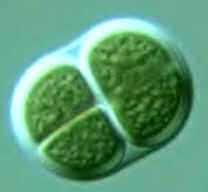 Crococcus |
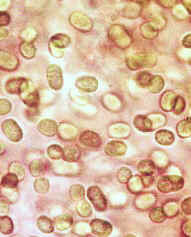 Cells of Anacystis |
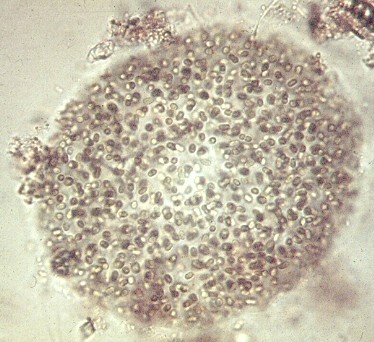 Anacystis Colony |
 Nostoc Ball (Colony) |
 Microscopic View of a Nostoc Colony |
 Nostoc Filaments seen with Phase Microscopy |
 Individual Noctoc Filaments from a large Colony (Phase Microscopy) |
 Anabaena |
 Oscillatoria |
 |
 Oscillatoria Embossed |
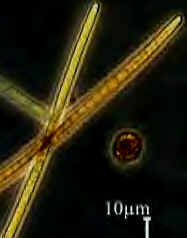 Planktothrix sp. |
 Lyngbya sp. |
 |
 |
| Spirlina sp. have a Spiral filament Morphology but the individual cells resemble those of Oscillatoria. | |
Filaments may be Branched, Unbranched or Clustered
 Calothrix |
 Tolypthrix |
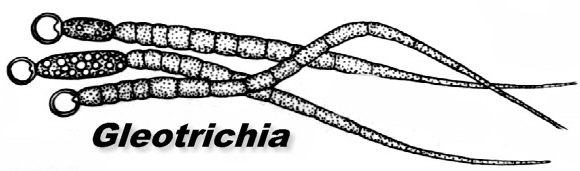
 Gleotrichia Colony |
 Gleotrichia Individuals |
 |
|

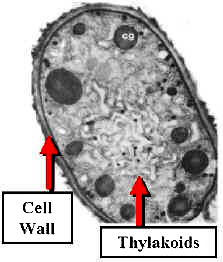
Cyanobacteria are Prokaryotes.
They have No Nuclear Envelope &
No Membrane-Bound Organelles

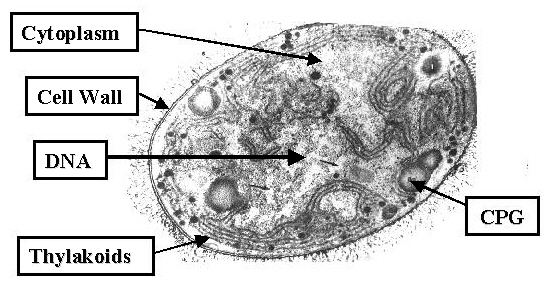
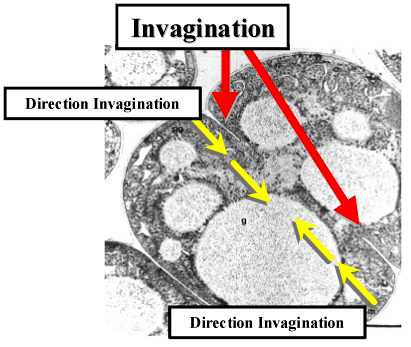
They have Photosynthetic Thylakoids which contain Chlorophyll a and the other photosynthetic pigments.
These are Invaginations of the Plasmalemma.
Cyanophycin Granules (CPG) contain Amino Acids carbohydrates.
|
 |
| Heterocysts seen with different types of Light Microscopy | |
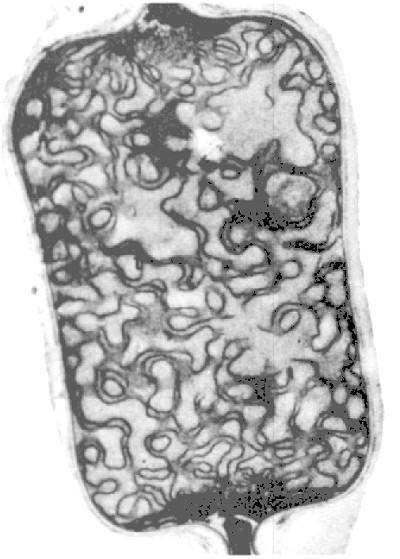 Heterocyst seen with an Electron Microscope |
|
Heterocysts are the sites for the fixation of atmospheric Nitrogen.
They are Vegetative cells that are converted into Heterocysts.
The Thick Cell Walls are relatively impervious to Oxygen and this helps to create an anaerobic environment inside the Heterocyst.
The internal Membranes are thylakoids that have lost Chlorophyll. They provide the sites for Nitrogenase.
Other cell contents are generally lost. This helps to explain the lack of detail seen with the light Microscope.
| SEM of Rivularia sp. showing the Pore (arrow) that connects the Heterocyst (H) to a Vegetative cell (V) |  |
Heterocysts are connected to the Vegetative Cells through a special pore in their end walls. These are much larger than the Microplasmodesmata.
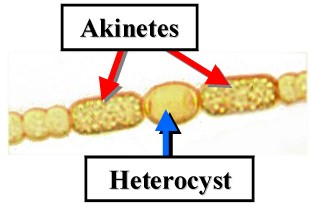 |
 |

Larger Image of an Akinete
Survive unfavorable Conditions
They contain Storage Products
Cyanophycin Granules (Amino Acids)
Lipids
 Anabaena with a nearly translucent Sheath: Identify the Round Smooth-looking Cell. |
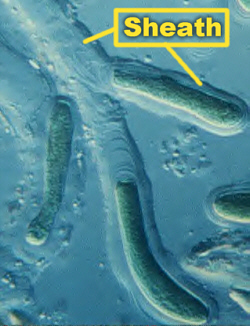 |
Provides a Buffering Microenvironment.

Some are Digestive Enzymes.
Provides Protection from the Environment this aids in
Asexual Reproduction
Function =Secretory?
Center of Cell

Low light -> Many
High Light -> Few
Oscillatoria Thylakoids = 20% Dry Weight

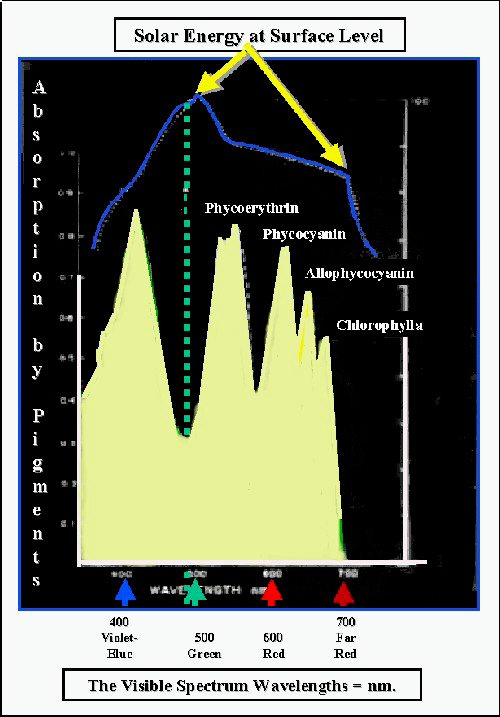
Accessory Pigments
Thylakoids have a Precise Spacing
 the
Phycobilisomes which are
attached to the Surface of the Thylakoids
the
Phycobilisomes which are
attached to the Surface of the Thylakoids
These include the following Pigments.
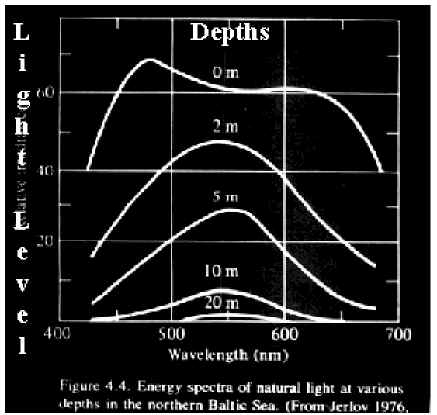
C-Phycocyanins Absorb Green-Yellow Light (615-620A).
Allophycocyanins Absorb Orange-Red (650-670A)
C-Phycoerythrin Absorbs Green Light (495-570)



 Aerial View of a Large Cyanobacterial Bloom |
|
 Microcystis Bloom |
 |
 Cyanophyte Bloom |
|

Terrestrial Environments
Pioneering Organisms contribute fixed nitrogen & some biomass.
They may be Free Living
Nostoc Balls can grow on bare soil including Volcanic Sites.
They can be Epiphytic and even Epizooic.
Their Symbiotic relationships with Lichens is ecologically important.
Other symbiotic relationships are significant of the plants which have them.
Azolla can carpet the surface of small lakes and ponds. This can be a major, local ecological effect.
The symbiosis with Hornworts (Anthocerophyta) may have ecological significance in Hawaii because Hornworts colonize disturbed sites like pig runs and runoff streams.
Fresh Water
Cyanobacteria can grow in thermal Hot Springs where algal photosynthetic organisms can't survive. They deposit limestone in the process. However, this is an extremely slow process.
They can
grow in low light environments due to their Phycobillin pigments.
They Release Carbon & Nitrogen Metabolites which can stimulate the growth of other organisms.
They can grow at low Oxygen levels and may enrich the local Oxygen concentration because the produce O2.
Resist Grazing by Protists this can lead to enhanced Cyanobacterial populations that can lead to "blooms".
Their relatively high tolerance to heat can lead to "blooms" caused by thermal pollution.
|
Link to Hawaiian Cyanobacteria from 
|
Black - Dark Gray - Red - Green - Yellow - Filaments 5 - 10 cm - Tangled with other species