 From Cell to Organ-3
The next level of
complexity which arose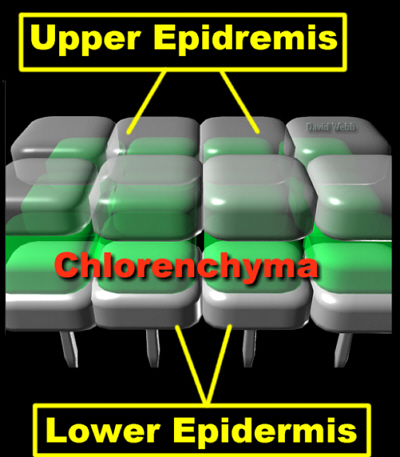 could have been a multilayered Thallus.
The cells on the bottom layer could have been specialized for water absorption. They might have had a thin Cuticle and hair-like projections called Rhizoids. Rhizoids are like root hairs. They are specialized for the absorption of water. They also anchor the thallus to the substrate. This would constitute a Tissue called Epidermis.
The next step could
be the formation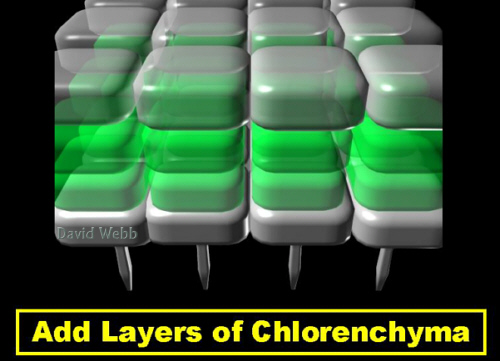 of a separate photosynthetic layer composed of Photosynthetic
Tissue called Chlorenchyma (a.k.a. Photosynthetic Parenchyma). The upper layer would loose its
photosynthetic abilities and become more specialized for water retention. It would
constitute another layer of Epidermal Tissue.
The Chlorenchyma is thus embedded within the two specialized Epidermal layers.
of a separate photosynthetic layer composed of Photosynthetic
Tissue called Chlorenchyma (a.k.a. Photosynthetic Parenchyma). The upper layer would loose its
photosynthetic abilities and become more specialized for water retention. It would
constitute another layer of Epidermal Tissue.
The Chlorenchyma is thus embedded within the two specialized Epidermal layers.
The next major
advance in plant evolution was the Stomata or a
stomata-like pore! This is one of the most important plant
adaptations.It allows plants to regulate gas exchange with the atmosphere. A solid
Epidermis with a thick cuticle would hamper gas exchange because Oxygen and Carbon Dioxide
can not readily pass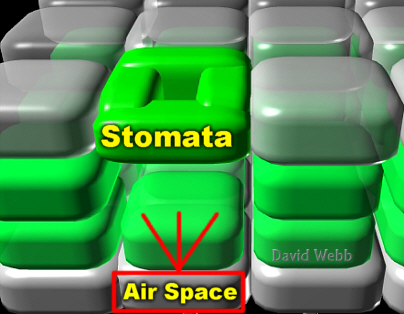 through the
Cuticle. Photosynthetic cells need atmospheric Carbon Dioxide which is present in very low
concentrations. Consequently, holes in the Epidermis would allow more Carbon Dioxide to
enter the thallus. However, water vapor would leave simultaneously at a high rate.
This would desiccate and damage the internal tissues. However, physiological control over
the opening and closing of the stomata allows the plant to balance these two conflicting
processes (CO2 uptake and H2O loss).
through the
Cuticle. Photosynthetic cells need atmospheric Carbon Dioxide which is present in very low
concentrations. Consequently, holes in the Epidermis would allow more Carbon Dioxide to
enter the thallus. However, water vapor would leave simultaneously at a high rate.
This would desiccate and damage the internal tissues. However, physiological control over
the opening and closing of the stomata allows the plant to balance these two conflicting
processes (CO2 uptake and H2O loss).
The formation of air spaces in the Chlorenchyma accompanied the formation of stomata. Such tissue is called Aerenchyma. These internal air spaces create gas reservoirs where Carbon Dioxide can accumulate so that photosynthesis can proceed when the stomata are closed.
Further specialization might have led to the formation of many layers and different shapes of Chlorenchyma to maximize photosynthetic capacity.
Our theoretical Organism has developed TISSUES. Tissues are groups of cells which are structurally/functionally distinct.

The Genus Marchantia (Hepatophyta) displays many of these traits.
