|
Pterophyta - 3 |
|
|
|
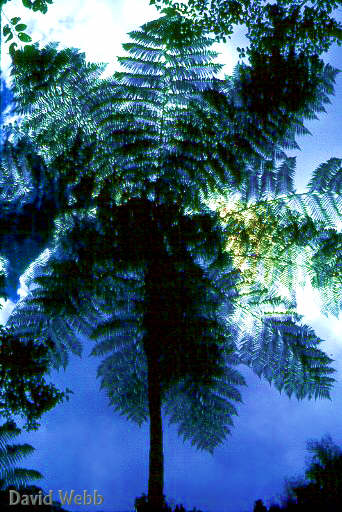
The Stems are usually subterranean. These can be a Caudex (erect) or a Rhizome (horizontal). Some species have Stolons (above ground & horizontal) or Erect Aerial Stems. Tree ferns are an example of the latter.
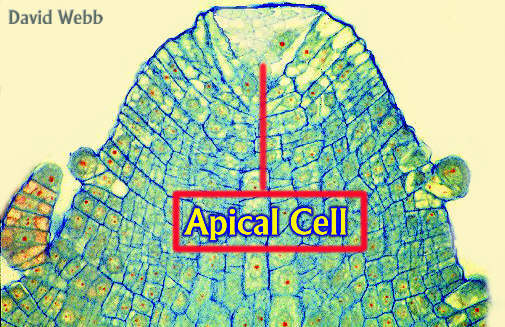
The Meristem organization in Ferns is an Apical Cell |
|
Branching is sporadic and may be dichotomous or lateral. There is little internodal elongation in most species. However there are vines which are exceptions.
Careful examination of a tree fern stem will show that it is composed of leaf bases which are close together or contiguous.
 |
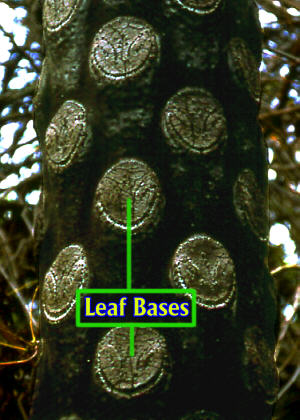 |
| Dicksonia Stem. Dicksonia is a Tree Fern. The light circles are Leaf Scars. These form when leaves are shed. The Brown Material is composed largely of Adventitious Roots. | |
The first image (A) shows that over half of the stem's diameter is due to a thick layer of brown Adventitious Roots. These roots originate at the highest levels of the stem & intertwine as they grow towards the soil. This is a highly inefficient way to develop a root system. Leaves depart from the stem at a 45 degree angle. They are overgrown at their base by the roots. This makes it hard to distinguish the Epidermis from the brown covering of roots. The other images (B & C) show the stem in greater detail. The immediate area surrounding the stem is composed of Petioles which join the stem at a lower level. The Epidermis is found just inside these. Look for Petioles which have clearly separated from the stem. They are completely enclosed by brown material. The Epidermis is the interface between the dark outer area and the light tissues of the stem. The stem outline is lumpy due to Petioles which have not completely separated from the stem. The Stele is circular in outline (C) however, it looks like a Star with many rays. The central area is a Pith and has a light color. The outer edge of the stele is dark brown. The Rays are Leaf Traces. They are parts of the stele which have diverged towards the leaf bases leaving behind Leaf Gaps. Look for areas along the theoretical stele circumference (red circle) which do not have Vascular Tissues. The Vascular Tissues have a dark brown color. |
|
The lack of internodal elongation is an obvious limitation in an environment that contains angiosperms that have extensive internodal elongation. Angiosperms can quickly form a dominant canopy which intercepts most of the photosynthetically active radiation (PAR).
The manner in which roots originate from aerial stems must also impose a limitation on the overall growth of the root system and the entire plant. New roots are formed near the stem tip. They need to grow externally from the top of the plant to its base where they enter the soil. Consequently, the root is exposed to desiccating conditions as soon as it leaves the stem & it remains so until it enters the ground. Roots are either killed or become dormant during dry periods. This applies to new & old roots! A root system that is entirely subterranean does not have these problems. The roots probably help to stabilize the upright stems of Tree Ferns. This is a positive adaptation. However, we will see that Conifers and other seed plants have solved this problem.