|
|||
 Araucaria sp. |
Many Gymnosperms produce copious amounts of resin. This becomes obvious when a tree is wounded or cut down. The Pitch Pine (Pinus resinosa) is so named because it produces mountains of you guessed it PITCH. Turpentine is refined from the resin of Pinus . | ||
 |
Outer region of an Araucaria stem just after it was severed. Note the white "pitch" which is exuding from the outer part of the stem. This area includes xylem & phloem. | ||
 |
The same stem as above but after a few minutes. The resin or pitch probably is defensive. It would seal smaller wounds and deter microbial invasion. It would also deter insects. | ||
 |
Transverse section of a Pinus twig at low magnification. Note the many large oval structures in the outer part of the stem. These are secretory ducts or resin ducts in this particular case. The light blue areas in the Xylem (red tissue) are one and the same. | ||
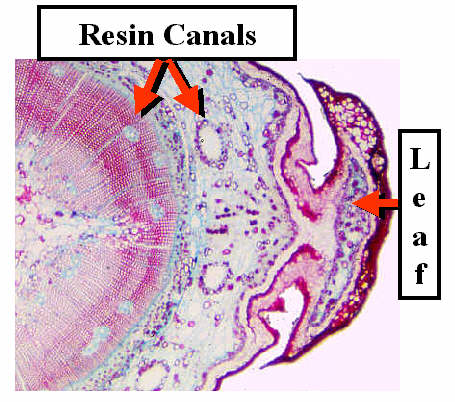 Same as above but at a higher magnification. Resin Canals are a specific type of Secretory Canal (Duct) |
|||
 |
Resin Duct from a Pinus species. Note the Epithelium which is more than one cell thick. These occur throughout the plant body. | ||
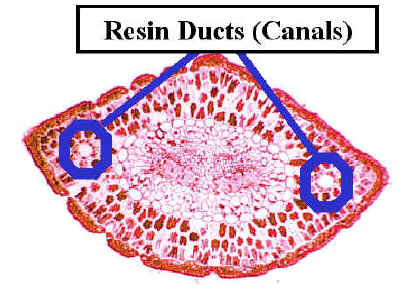 Resin Ducts (Canals) in a Pine Leaf (Needle) |
 Resin Duct in a Spruce Leaf |
||
| Lecture Directory |  Prior Page |
 Home Page |
 Next Page |
|---|---|---|---|

