|
|||
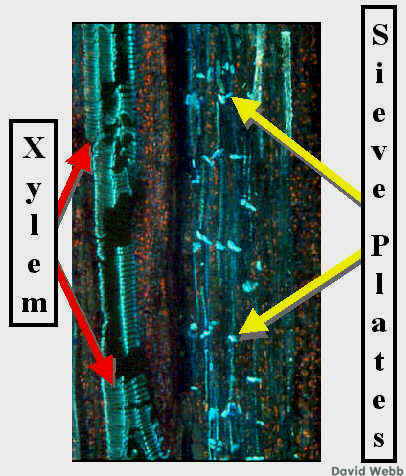 Long section through Cucumber stem, stained with Aniline Blue, viewed with Ultra-Violet fluorescence.
|
Aniline
Blue fluoresces when it is illuminated with Ultra-Violet light. Other substances in
the xylem walls also fluoresce. The latter is called autofluorescence.
The red fluorescence is due to autofluorescence
by chloroplasts. |
||
| A closer inspection of the Phloem reveals the Sieve Plates which have transverse and somewhat inclined dispositions. A Sieve Tube is clearly seen on the right side of the picture. The lateral walls of STMs may also have Sieve Pores. These also contain Callose and fluoresce as expected. These can be clearly seen in the Sieve Tube on the right. | |||
 |
Enlargement of the two Sieve Plates from the lower left corner of the image above. Note the blue color as well as the fluorescence. Both are due to the presence of Callose & Aniline Blue. | ||
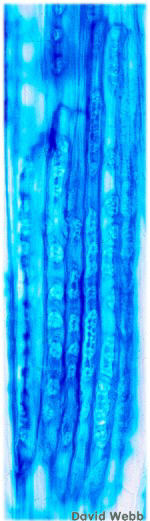 Sieve Cells |
There are two types of Sieve Elements. These are Sieve Cells
and Sieve Tube Members. Note the similarity to xylem
nomenclature. Sieve Cells lack Sieve Plates. They have Sieve Pores on their lateral walls. These may be concentrated where
endwalls overlap but they are less specialized than Sieve Plates. Sieve
Cells tend to be narrow and elongate with overlapping end walls. Sieve Tube Members are shorter, wider and are more rectangular in shape. Their endwalls are more or less transverse or slightly inclined. STM are found in Angiosperms. Sieve Cells are characteristic for gymnosperms and seedless plants. |
||
 Lecture Directory |
 Prior Page |
 Home Page |
 FirstPage |
|---|---|---|---|


