|
|
|
We will examine the flowers and fruits of the Brassicacae because Capsella is frequently used as the model for dicot embryo development, and because this is an important family from a human perspective. It produces many leaf crops like Watercress, Cabbage, Chinese Cabbage and Brussels Sprouts. Chinese radish, plain old radish, horseradish, Japanese horseradish and turnips are important root crops. When we eat Broccoli we are actually eating an inflorescence. Finally, this family is the source of Mustard which along with Ketchup are dietary staples in the USA! This family is commonly known as the Mustard family and it was formerly called the Crucuferae.
The Placentation is Parietal and the Fruits are Capsules. However, a "false partition" grows from one of the placentae and divides the locule in half. Some of the Seeds adhere to this and may be dispersed because the mature structure is very light. The fruits are called Siliques.
 Watercress Flowers & Fruits |
 Diagram of Wallflower (Cheiranthus Cheiri) Flowers and Fruit |
 Diagram of a Capsella Flower |
 Photo of a Capsella Flower |
 Androecium and Gynoecium of Brassica: Note the two lobes of the Stigma and the lobed nature of the Ovary. Both indicate that the Gynoecium is composed of two carpels. |
 Illustration of a Dehiscent Silique: Note the two lines of Dehiscence as well as the "False Partition" and Seeds. |
 Capsella Ovary |
 Capsella Ovary Labeled |
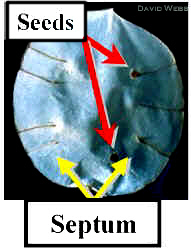 False Partition (Septum) from the Money Plant |
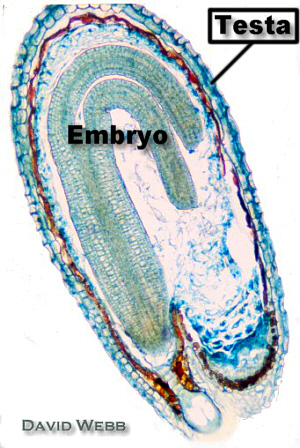 Mature Capsella Seed |


