|
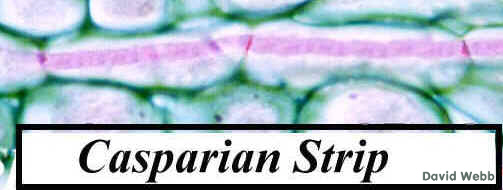
Endodermis |
 |
|
Endodermis |
|
 |
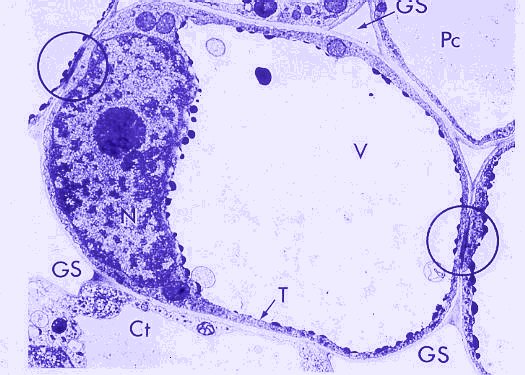 |
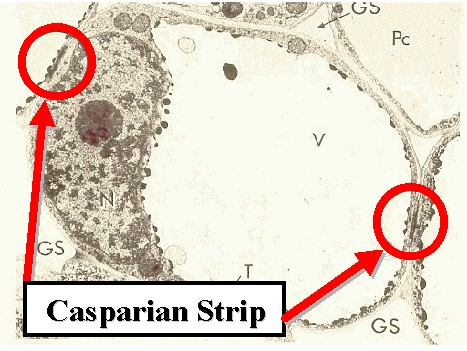
An Endodermal cell seen with an Electron Microscope. It looks like a Parenchyma cell except that there are no large Plastids. Note the Circles on the Radial Walls of the right-hand image above! Ct = Cortical Cell; GS = Gas Space; Pc = Pericycle Cell (The
Pericycle is a layer(s) of parenchyma-like cells which is located between the endodermis
and the Vascular tissues of the Stele); |
|
|
|
| Same as above but Labeled to show the location of the Casparian Strip! | |
|
|
High Magnification view of the Casparian Strip (CS) as seen with an Electron Microscope. Note that the dense material permeates the entire cell wall and middle lamella of both cells. This is due to the presence of Suberin. The Plasmalemma is firmly attached to the CS. The black globules are in the Vacuole and are touching the Tonoplast. Locate the Cytoplasm and the Plasmalemma! |
|
 |
|
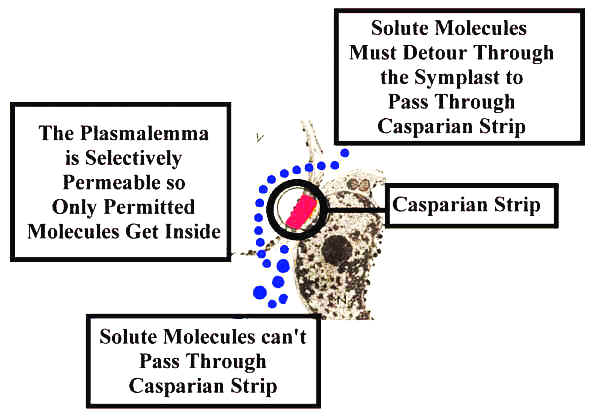
| In the Absence of a Casparian Strip, Solute Molecules would become equally concentrated on each side of the Endodermis. | |
   |
|
| The Endodermis
can exclude solute molecules if the Plasmalemma is
impermeable to them. Alternatively, it can also accumulate molecules against a concentration gradient with the expenditure of ATP. Thus, it helps to create concentration gradients. Concentration gradients are important for the control of water uptake and transport, and it all starts right here at your friendly neighborhood Casparian Strip! |
|
Thus, solute and solvent (water) movement are brought under the regulation of living cells. This may not sound very impressive but if it weren't for the Casparian Strip we would all be eating Algae. Furthermore, there would be no shade, no cloth, no wood and no classes like this!!!

 Root Directory