Monomerous thalli .....
 Monomerous thalli .....
|
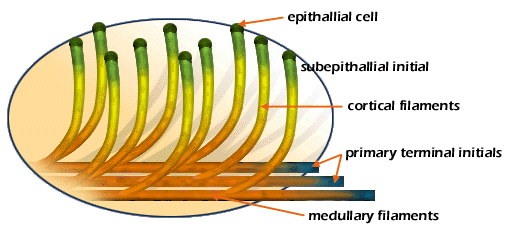
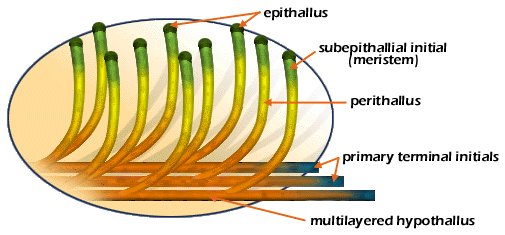
| In monomerous thalli, there is a single system of repeatedly branching filaments. In dorsi-ventrally oriented species, there is usually a layer if filaments located near the substratum, fromwhich branches repeatedly arise and curve towards the dorsal surface. |
 Note that the cortical filaments in this example contain only a few cells |
|
| Under the traditional terminology that was applied to corallines, the lower filaments were referred to as a the hypothallus, while their dorsally curving derrivatives were referred to as the perithallus. |
| This terminology suggests that corallines are somehow different from other red algae with respect to the origin of these filaments. However, monomerous thalli are homologous with multiaxial thalli in many erect red algae, in which the inner filaments are referred to as the medulla and their outward derrivatives are called the cortex. |
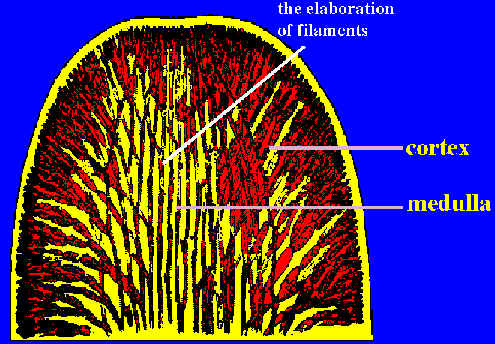 |
| To emphasize this commonality with other multiaxial red algae, the ventral layer of filaments are referred to here as the medulla, and their peripheral derrivatives are referred to as the cortex. We can also speak of medullary filaments and cortical filaments, to refer to the filaments which make up the medulla and cortex respectively. |
 |
|
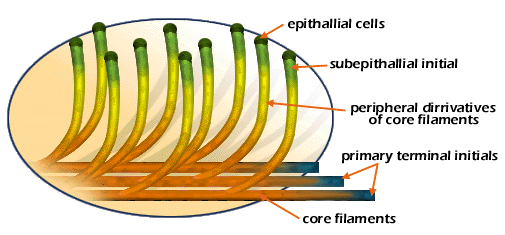
| Woelkerling (1988) makes use of the terms core filaments for what is called the
medulla here, and peripheral derrivatives of core filaments for what is called the cortex here. These terms obscure the relationship with other red algal thalli, but refer to the same structures. Medulla and cortex are much easier for phycologists familiar with other algae to relate to, and for non-phycologists, there is one system of terms applied to all pseudoparenchymatous, multiaxial red algae. Since we want to make coralline algae as accessible as possible to phycologists, ecologists and others, we use medullary filaments (medulla) and cortical filaments (cortex) here and in all publications. |