|
Lycophya-Selaginella-Repro-2
|
|
Selaginella is another major Genus in the Lycophyta. It has many similar features with Lycopodium. I want to concentrate on the reproductive traits of Selaginella which are significantly different from Lycopodium. Selaginella is Heterosporous!!
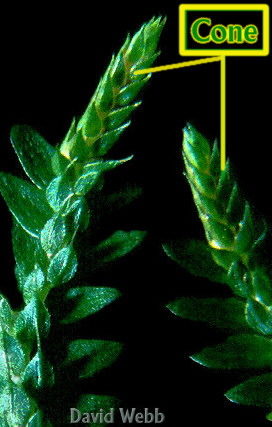
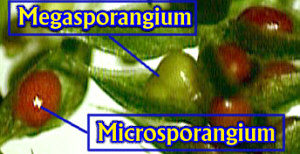
The Sporophylls of All Species are assembled into Cones.The Cones occur at the tips of short branches.Selaginella is Heterosporous. It produces Microsporangia which have many small Spores. These resemble the sporangia and spores of Lycopodium which is Homosporous.Selaginella also forms Megaspores in Megasporangia. There are only Four Megaspores in each Megasporangium. The Megaspores are large compared to the Microspores. The four Megaspores contain the same biomass as all of the Microspores. This accounts for the size disparity. Why might this be advantageous for successful sexual reproduction?The Sporangia occur in the leaf axils. There are no obvious differences between the leaves which bear Megasporangia or Microsporangia. There is usually a color difference between Megasporangia and Microsporangia. Due to the size of the Megaspores, the outline of the Megasporangium may be distorted, as well. There are various distribution patterns for Micro & Megasporangia in the cones. They are NOT randomly arranged. |
|