Chlorophyta-7
  Chlorophyta-7
Trichocine Group-2
Other progressions in growth form are seen in these organisms.
Klebsormidium will serve as a basal, unbranched growth form. It is very similar to Ulothrix.
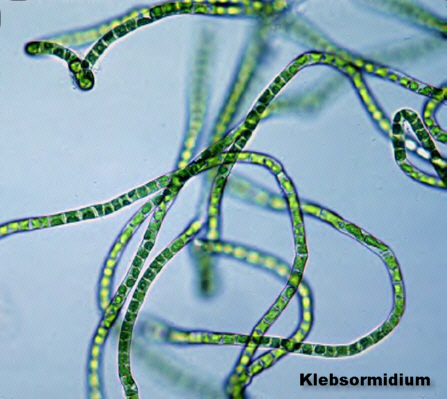 Klebsormidium is another example of a Filamentous, Uniseriate growth form. This alga grows readily on moist soil. |
 |
Branching in many planes would
produce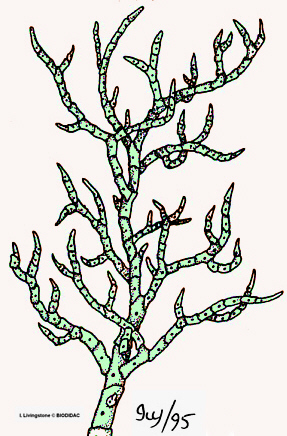 an
organism like Stigeoclonium.
an
organism like Stigeoclonium.
Further branching and the development of an Heterotrichous growth form would yield an organism like Fritschiella which also lives on moist soil.
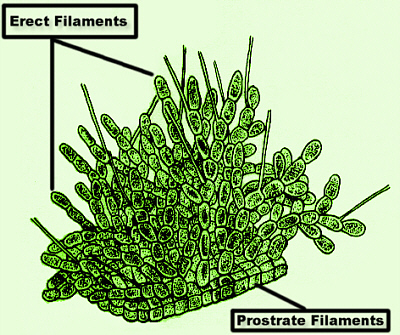
Heterotrichy (Other Threads) means that there is a complex assembly of filaments with some being horizontal and others being vertical. In case of Fritschiella some filaments are in contact with the substrate while vertical branches extend upwards. We have encountered this previously with the nongeniculate coralline Rhodophyta.
 |
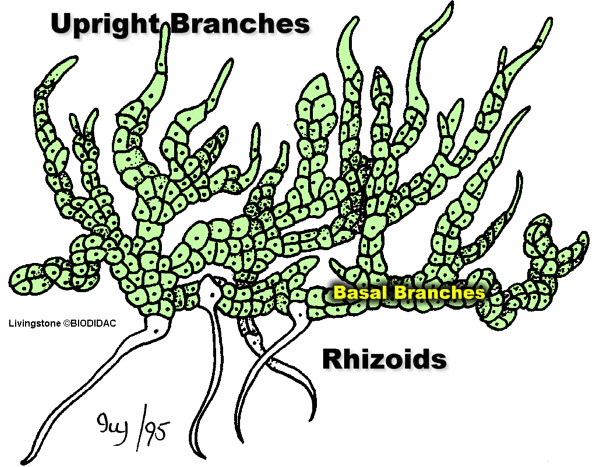 |
Fritschiella has a thick base which produces upright Branches and Rhizoids. This is an example of Heterotrichy. Fritschiella is thought to have reached the organizational level of Parenchyma tissue. It can live on moist soil and is regarded as a terrestrial as well as an aquatic alga. This growth form is considered vital for growth on land. The production of Rhizoids is noteworthy. Their principal function is anchorage in this case. Water and gasses are directly absorbed by all the cells in the thallus. |
|
Coleochaete
Coleochaete is a Genus that has world-wide distribution in freshwater habitats where it is an epiphyte on aquatic plants. There are five species with wide distributions. There are approximately 15 species overall.
Coleochaete means Sheathed Hair. The chaete part of the name refers to the spine-like cells which are produced. These are thought to deter herbivory.
Some species of Coleochaete are Heterotrichous. However, the formation of vertical branches is suppressed in some species.
 C. irregularis: This image of a young thallus shows the basic branching pattern of the horizontal system. These may produce upright branches eventually. Cell fusion occurs postgenitaly. Consequently, only "False Parenchyma" is formed. This is reminiscent of the Geniculate Corals (Rhodophyta). In true Parenchyma, adjacent cells have arisen from the division of the same "parent" cell. |
|
In some cases, upright Branches are NOT produced. This results in a disk-shaped thallus.
Cell Division is limited to the outermost cells. A radiating pattern of cells are produced and True Parenchyma is formed.
A Cell Plate & Phragmoplast are formed during Mitosis.
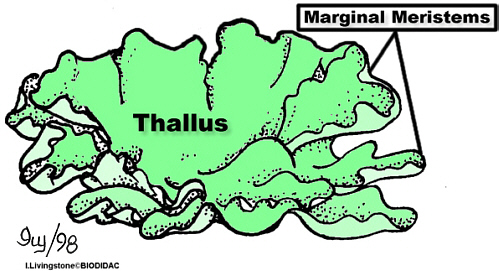
This is similar to what we saw with the Hornworts (Anthocerophyta).
 |
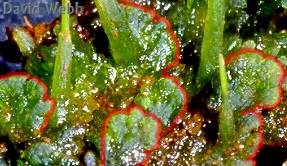 |
| Diagram of an Anthoceros (Hornwort) Thallus | Image of Anthoceros Thallus outlined to indicate the marginal meristems which produce a disk-like thallus. |
 Young Coleochaete Thallus |
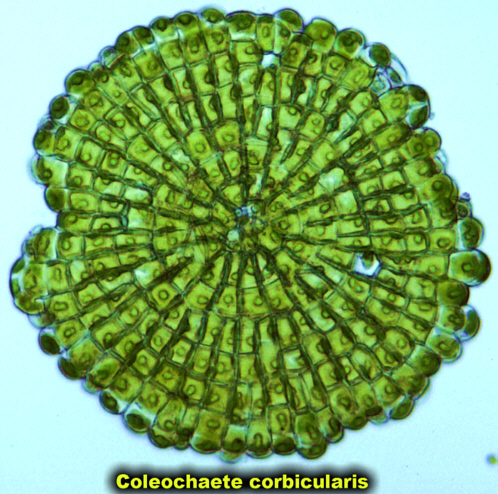 Older Coleochaete Thallus |
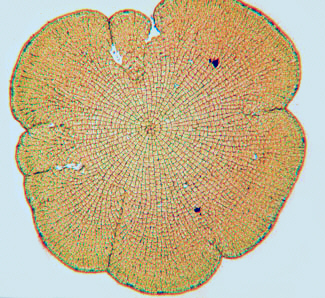 |
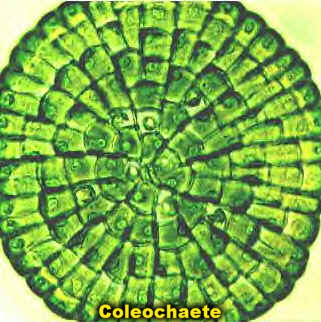 Note the Radial Cell Files in these Thalli. Meristematic activity is confined to the periphery of the thallus. |