 From Cell to Organ-2

Advantages of Multicellularity
Increased Volume of the Organism greatly increases the volume and total surface area of the cells and their membranes.
This enhances the ability to exchange chemicals with the environment, and provides local reservoirs for essential nutrients.
It allows the separation of absorptive and non-absorptive regions of the organism. This leads to cell and tissue specialization.
The accumulated effect of the cellular exoskeleton (cell walls) and the turgor pressure of many cells combined, provides a greater degree of structural support. This protects the organism from physical forces like the movements of air and water.
This also insulates or buffers them from minor changes in temperature or moisture as well as nutrient availability.
This also leads to larger organisms which can out compete other organisms for the resources available in the environment.
Parts of the plant may survive attack by an herbivore or pathogen and can regenerate complete organisms.
Larger organisms tend to have longer life spans.
Multicellularity also lends protection to reproductive structures.
It is inefficient
for one cell to perform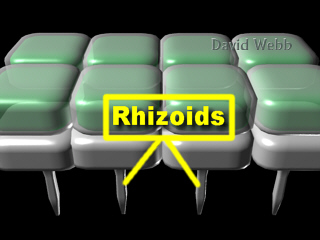 a multitude of functions. Consequently, cell specialization evolved. The most important basic functions for the survival of land plants are
acquiring
water,
retaining water,
translocating water,
performing photosynthesis and
transporting photosynthate (sucrose dissolved in water).
All of these involve water!
